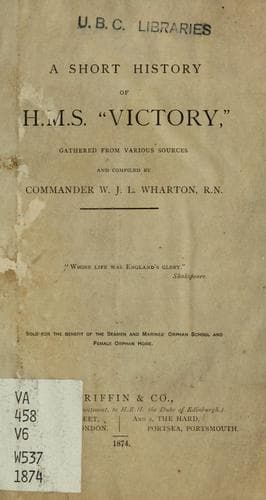
A Short History of H.M.S. VictoryWharton, W. J. L. (William James Lloyd)
History
A Short History of H.M.S. Victory
Wharton, W. J. L. (William James Lloyd)
Great Britain -- History, Naval; Victory (Ship)
Lord Hood cruised for a fortnight in sight of Toulon, then sailed for
Nice to show himself there, and on his return on 20th August, heard
that proposals were being made in Toulon to put themselves under his
protection. On the 23rd, Commissioners came on board the "VICTORY"
from Marseilles with full powers to treat for peace, offering a
conditional surrender of Toulon and all the shipping, declaring a
monarchical government the leading object of their negotiation, and
praying for speedy help against the armies of the convention that were
at that moment approaching.
Our space will not permit a full account of the proceedings at this
time, and we must satisfy ourselves by stating that Toulon was taken
possession of on the 27th August, without a blow, despite the
threatened opposition of Admiral St. Julien, the second in command,
who was thorough republican; the Spanish fleet hove in sight the same
day, and Toulon was soon occupied by the combined forces, and vigorous
steps taken to keep possession of our "extraordinary acquisition," as
Nelson in one of his letters calls it. But the enemy were at hand,
mustering stronger and stronger every day, and by November, General
Dugommier was besieging the town with 40,000 men, while the defenders,
who only mustered 16,000, were of different nationalities and had to
man a line 15 miles in length. On December 16th a position on the
heights commanding Toulon was carried by the besiegers, and a council
of war, hastily summoned, determined to evacuate the town, carry off
as many ships as possible, and burn the rest. The evacuation was
carried out successfully, the troops and seamen were all embarked, and
15,000 of the inhabitants took refuge from the rage of their
countrymen on board the fleets. But the rest of the programme was not
so completely performed; the Spaniards had charged themselves with the
destruction of the ships in the inner harbour, but either by
carelessness or treachery, they very imperfectly performed their task.
They did _not_ fire the ships of war but _did_ set alight to the
powder vessels which it was arranged should be scuttled; these blew
up, nearly destroying Captain Sidney Smith, who was burning the ships
in the outer mole; he gallantly attempted to repair the omission, but
was repulsed by the fire of the republicans who were already in the
town, and had to retire, leaving the work but half done. Of 58 ships
in the port when Lord Hood arrived, 14 were destroyed, 19 carried off,
and 25 left to the French.
Public-domain text, read in full here on John Shaqi.
Reviews
Reviews
No reviews yet
Be the first to share your thoughts on this work.
Join the Discussion
Join the discussion
Sign in to leave a comment or review.
Sign InorCreate an account