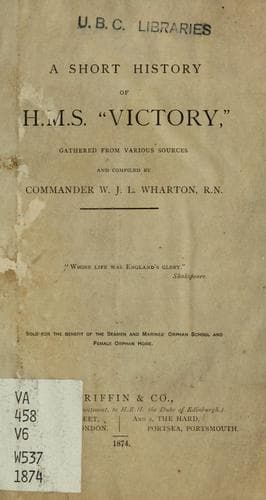
A Short History of H.M.S. VictoryWharton, W. J. L. (William James Lloyd)
History
A Short History of H.M.S. Victory
Wharton, W. J. L. (William James Lloyd)
Great Britain -- History, Naval; Victory (Ship)
Lord Hood then tried to persuade General Dundas, who commanded the
troops, of the practicability of taking Bastia, the capital of the
island; but that officer differed, and not only refused to take any
part in the attempt, but would not even lend a mortar or gun, or any
stores for the service, so that Hood had actually to send to Naples
for these most necessary articles for a siege; for, probably believing
that the energy of Nelson, then Captain of the _Agamemnon_, who had
borne a most prominent part in these previous undertakings, was
sufficient to carry anything through with success, the Admiral
determined to attempt it alone with his sailors, and 1000 men of
different regiments who were embarked in the ship as marines. He
cruised in the "VICTORY" for some days, before Bastia, and then
returned to San Fiorenzo, leaving everything to the direction of
Nelson, who worked as he always did, untiringly. On April 4th Hood
again went round and assisted with his men, etc., in raising the shore
batteries; and on the 11th, when all was ready, a boat from the
"VICTORY" went in to demand the capitulation of the town. This was
refused with scorn, by the brave Frenchman, St. Michel, who replied,
that he "had red-hot shot for our ships, and bayonets for our men;"
the "VICTORY," on receiving this reply, hoisted a red flag, the
preconcerted signal, and immediately the batteries opened. The town
replied, and for some weeks the siege went on with varying success.
During this period General D'Aubant, who had succeeded General Dundas,
would ride over with his staff from San Fiorenzo, a distance of only
twelve miles, and watch the operations, his own men remaining inactive
the while, and it was his extraordinary conduct that urged the seamen
to exertions of which they might otherwise have been incapable. The
fire of the besiegers grew hotter and hotter; new batteries were
erected, and guns mounted on heights deemed insurmountable, and on
19th May, their efforts were rewarded by a boat from the town coming
on board the "VICTORY," with a proposal of surrender.
The preliminaries were speedily arranged, and on the 22nd the town
and two frigates were given up. "When I reflect on what we have
achieved," says Nelson in a letter to his wife, "I am all
astonishment. I always was of opinion, have ever acted up to it, and
never have had any reason to repent it, that one Englishman was equal
to three Frenchmen."
Public-domain text, read in full here on John Shaqi.
Reviews
Reviews
No reviews yet
Be the first to share your thoughts on this work.
Join the Discussion
Join the discussion
Sign in to leave a comment or review.
Sign InorCreate an account