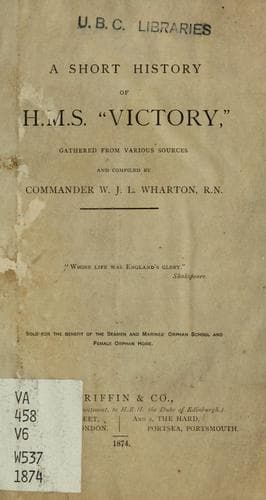
A Short History of H.M.S. VictoryWharton, W. J. L. (William James Lloyd)
History
A Short History of H.M.S. Victory
Wharton, W. J. L. (William James Lloyd)
Great Britain -- History, Naval; Victory (Ship)
The "VICTORY" next proceeded to Genoa, and in the first week of
November, she left for England, taking Lord Hood with her, his health
not being able to stand the fatigues of the command any longer. She
arrived at Portsmouth in December, and Lord Hood went on leave, but
rehoisted his flag on the 14th April following, after the ship had had
a thorough refit.
On May 1st, 1795, the "VICTORY" was again a spectator of the
destruction of a sister first rate, the _Boyne_ of 98 guns, which
caught fire and blew up at Spithead, where remnants of her remain to
this day off Southsea Castle, marked by a green buoy.
On 2nd of May, as Lord Hood was on the point of leaving to resume his
command, he was ordered to strike his flag, and "VICTORY" sailed out
on 24th May, as a private ship,[B] with Rear-Admiral Man, who was
taking a reinforcement out to Admiral Hotham, then confirmed
Commander-in-Chief in the Mediterranean. Man joined Hotham's fleet off
Minorca on June 14th, and on 8th July, on the fleet weighing from San
Fiorenzo Bay, to pursue the enemy, he shifted his flag to the
"VICTORY."
[B] "A private ship" is a man-of-war that does not have an
Admiral on board.
The French fleet of 17 sail, under Admiral Martin, were sighted off
Hyères at daylight on July 13th, and the signal for a general chase
was thrown out by the _Britannia_, Admiral Hotham's flagship.
The "VICTORY" was always celebrated for her good sailing qualities,
and on this occasion they shone out particularly conspicuous, for, at
half-past noon, she, with the _Culloden_ and _Cumberland_, came within
range of the rearmost of the enemy, while the rest of their companions
were astern at distances ranging from 1 to 9 miles, the
Commander-in-Chief being one of the farthest, for the _Britannia_ was
as bad a sailer as the "VICTORY" was a good one. They opened fire,
but at this moment the wind unfortunately failed, and they were unable
to get into close action, though at the end of an hour the _Alcide_, a
seventy-four, struck. They still hoped to make more prizes, but had by
four o'clock drifted so near the shore, that the signal to discontinue
the action was made, and the French escaped through the shoals, the
passages between which they were familiar with, into Fréjus Bay.
The _Alcide_, which had made a most gallant defence, unluckily took
fire shortly after striking, and blew up with the loss of all her
crew, save 200. In the skirmish, the "VICTORY" was the greatest
sufferer, having her rigging much cut, and all her lower masts badly
wounded. She lost 5 killed (2 officers), and 16 wounded.
Public-domain text, read in full here on John Shaqi.
Reviews
Reviews
No reviews yet
Be the first to share your thoughts on this work.
Join the Discussion
Join the discussion
Sign in to leave a comment or review.
Sign InorCreate an account