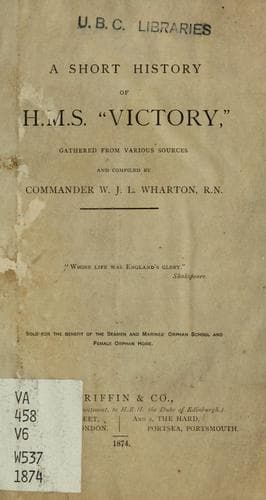
A Short History of H.M.S. VictoryWharton, W. J. L. (William James Lloyd)
History
A Short History of H.M.S. Victory
Wharton, W. J. L. (William James Lloyd)
Great Britain -- History, Naval; Victory (Ship)
On May 10th he put into Lagos Bay to get more provisions, and on the
11th, having sent the _Royal Sovereign_ back to the Mediterranean, as
a slow sailer who was likely to hinder him, he started in pursuit of
the 18 ships of the enemy, with but 10 of his own. His anxiety at this
time was extreme; he was very ill, and had been told by his physicians
that he ought to go home, but "salt beef and the French fleet is far
preferable to roast beef and champagne without them;" he writes, "my
health or my life even must not come into consideration at this
important crisis." Captain Hardy is reported to have said to him, "I
suppose, my Lord, that by crowding all this sail you mean to attack
those 18 ships?" "By God, Hardy," said he, "that I do;" and on the
passage over, he took every opportunity of making his plans known to
his captains, that a success might be ensured if possible. Barbadoes
was reached on June 4th, and here he received information that led him
to suppose that either Tobago or Trinidad was the object of the
combined fleet, who had been seen on the 28th May, and, embarking 2000
men, he hurried on for the latter island. Off Tobago he received
corroborative news from an American schooner, who must have deceived
him on purpose and all was preparation in the English fleet.
Early on the morning of the 7th June, the ships stood along the north
shore of Trinidad; and had anything been wanting to confirm the
intelligence they had received, it was supplied in the conflagration
of a battery, that protected a little cove in the steep coast, and the
flight of its garrison, who were seen speeding away in the direction
of the town. The remembrance of Aboukir Bay rose in their minds, every
man expected that the deeds of that glorious day would be repeated in
the Gulf of Paria, and as the ships sailed, prepared for battle,
through the Bocas of Trinidad, expectation was strained to the utmost,
to catch the first glimpse of the enemy they fully relied on seeing on
rounding the point.
What was their astonishment then on coming in view of the town, to
find the Union Jack still waving over the forts, and no French
men-of-war to be seen.
Nelson at once anchored for the night without communication, and early
next morning sailed for Grenada.
Public-domain text, read in full here on John Shaqi.
Reviews
Reviews
No reviews yet
Be the first to share your thoughts on this work.
Join the Discussion
Join the discussion
Sign in to leave a comment or review.
Sign InorCreate an account