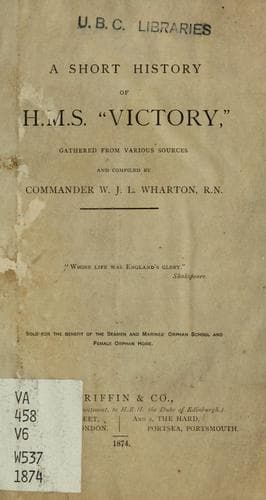
A Short History of H.M.S. VictoryWharton, W. J. L. (William James Lloyd)
History
A Short History of H.M.S. Victory
Wharton, W. J. L. (William James Lloyd)
Great Britain -- History, Naval; Victory (Ship)
_Arethusa_ a dismantled hulk, to be found by the _Valiant_, and towed
home. This action is perpetuated in the well-known sea song, the
"Saucy Arethusa."
From the _Licorne_, Keppel learnt the unexpected and unpleasant
intelligence that the French fleet in Brest amounted to 32 sail of the
line and 12 frigates; as his own only numbered 21, prudence dictated a
return for reinforcement, and he very unwillingly turned his back on
France, anchoring at St. Helen's on the 27th of June, and detaining
another French frigate, the _Pallas_, on his way.
On the 10th of July, war being now declared, he again sailed, with 25
sail of the line, and was joined off Plymouth by 5 more, making his
total force 30 of the line and 4 frigates; with these he now proceeded
in search of the French Admiral D'Orvilliers, who, with 32 ships of
the line and many frigates, had left Brest a few days before, hearing
that the expected British merchant fleets were at hand. The object of
the French was, of course, the capture of these rich prizes, and they
naturally wished to avoid a meeting with the British men-of-war before
this was accomplished. On the other hand, the English longed for the
battle, as the shortest and safest mode of saving their convoys. So
when the two fleets sighted one another on the 23rd, the French, being
to windward, did their best to avoid an engagement, and held their
wind; on which Keppel finding he had no chance of overtaking them if
he kept his line of battle, hoisted the signal for a general chase,
and kept it flying.
Thus for four days were both fleets working to windward, during which,
two French line of battle ships were cut off, but from their superior
sailing escaped capture. Keppel hoped that D'Orvilliers would bear up
to their rescue, but the wily Frenchman knew that if he did, he would
have to give up all hopes of his prize, and preferred that his stray
vessels should trust to their heels, which as we have seen, bore them
in good stead on this occasion. However, this made the two fleets
numerically equal, and, on the forenoon of July 27th, being then some
100 miles west of Ushant, the joy in the British fleet was excessive,
when they found that a shift of wind brought them into such a position
that an engagement was inevitable. The French still tried to evade the
fight, and put about on the other tack, bringing the heads of the two
lines pointed in nearly opposite directions, and in this way the
British van, commanded by Sir R. Harland, came in action with the
French centre, and standing on until close to their line, ran along it
to leeward. The rest of the fleet followed, taking their positions in
the line as quickly as they could, the "VICTORY" being in about the
centre.
Public-domain text, read in full here on John Shaqi.
Reviews
Reviews
No reviews yet
Be the first to share your thoughts on this work.
Join the Discussion
Join the discussion
Sign in to leave a comment or review.
Sign InorCreate an account