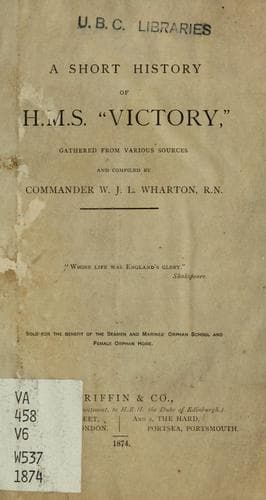
A Short History of H.M.S. VictoryWharton, W. J. L. (William James Lloyd)
History
A Short History of H.M.S. Victory
Wharton, W. J. L. (William James Lloyd)
Great Britain -- History, Naval; Victory (Ship)
On the morning of this day, the remnant of the enemy's ships put to
sea to attempt to recapture some of their friends, but the gale coming
on, the only result was the loss of two more of themselves, one of
which fell into our hands before going ashore. The "VICTORY," with
the small amount of sail she could show to the gale, laboured deeply
in the heavy sea, and on the 24th, when the wind moderated a little,
she was taken in tow by the _Polyphemus_. In the afternoon, managing
to rig up some jury topmasts and a mizen-mast, she was more
comfortable, but at 5 p.m. next day, on the storm increasing, the
towing hawser parted, the mainyard carried away, and her sails split
to ribbons. With nothing now to steady her, the "VICTORY" rolled
dangerously and unmanageably, and an anxious night was passed, but
happily for her as well as other of our ships, the violence of the
wind abated in the morning, and the _Neptune_ taking her in tow, after
two days brought her safely into Gibraltar.
In the meantime Lord Nelson's remains had been placed in a cask of
brandy, as the best means at hand of preserving them, and on the 3rd
of November, having refitted, the "VICTORY," accompanied by the
_Belleisle_, sailed on the melancholy duty of conveying the body of
her hero to England, and, after a most boisterous passage, reached
Spithead, on December 4th.
Here she was the object of a most intense and reverential attention,
her battered sides, with, in many places, the shot yet sticking in
them; her still bloody decks; her jury masts and knotted rigging;--all
attested the severity of the ordeal she had gone through; while the
flag that still waved, but at half-mast, reminded the spectator that
the great Admiral who had such a short time before sailed from that
very anchorage to victory, had now, also, returned to his grave.
Amongst other injuries, the "VICTORY'S" figure-head, a coat of arms
supported by a sailor on one side and a marine on the other, was
struck by shot, which carried away the legs of the soldier and the arm
of the sailor, and the story goes (but we cannot vouch for its truth),
that all the men who lost legs in the action were marines, and those
who lost arms sailors. The figure-head is still the same, but the
wounded supporters have been replaced by two little boys, who, leaning
affectionately on the shield, seem certainly more fitted for the
peaceful life of Portsmouth Harbour than for the hard times their more
warlike predecessors lived in.
Public-domain text, read in full here on John Shaqi.
Reviews
Reviews
No reviews yet
Be the first to share your thoughts on this work.
Join the Discussion
Join the discussion
Sign in to leave a comment or review.
Sign InorCreate an account