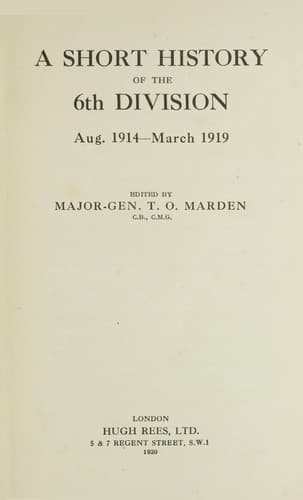
A Short History of the 6th Division: Aug. 1914-March 1919
History
A Short History of the 6th Division: Aug. 1914-March 1919
Great Britain. Army. Division, 6th; World War, 1914-1918 -- Campaigns -- Western Front; World War, 1914-1918 -- Regimental histories -- Great Britain
The Division had taken part as a whole in three general attacks on the
Somme (15th and 25th September and 12th October), and had also carried
out subordinate operations on 13th and 18th September and 18th
October.
It had suffered casualties amounting to 277 officers and 6,640 other
ranks, and had well earned a rest.
CHAPTER VII
LOOS SALIENT
1916-17
On 25th November the Division took over the La Bassee sector, which
included the famous Givenchy Ridge and Cuinchy Brickstacks. After
about a month it side-stepped to the Cambrin-Hohenzollern Quarries
front of about 5,500 yards, where it remained until the 28th February
1917. All this front had a most evil repute, but so exhausted was the
enemy by the Somme fighting that this four months' trench sojourn
proved the quietest the Division ever experienced, except before the
storm of March 1918, and the casualties would have been far fewer had
it not been for several raids carried out by us.
The machine-guns of the Division were strengthened on 15th December by
the arrival of the 192nd M.G. Company, and on 2nd January 1917
Lt.-Col. G. F. B. Goldney, D.S.O., succeeded Lt.-Col. H. R. S.
Christie as C.R.E., the latter having been nearly a year with the
Division.
On the 1st March the Division took over a 11,000 yards' front
extending north from the Double Crassier at Loos with sectors
Loos--14bis--Hulluch--Hohenzollern, all three brigades being in line
and a brigade of the 21st Division also which came under the command
of G.O.C., 6th Division.
March and the first portion of April were notable for raids and
counter-raids, and for considerable artillery and trench-mortar
activity, which gave place to more or less continuous fighting
consequent on the withdrawal of the enemy opposite the right of the
Division after the successful attack by the Canadians at Vimy.
Notice was received on the morning of the 13th April that a
withdrawal was contemplated by the enemy opposite part of the
Divisional front. The right section of the front was at that time held
by the 16th Infantry Brigade, with the 2nd York and Lancaster Regiment
on its right. On the 13th April the withdrawal commenced, the enemy
being so closely followed up by the York and Lancaster Regiment that
by 6.20 p.m. the brigade was able to report the Railway Triangle in
our occupation, and the whole of the battalion in the enemy's
trenches. Our troops were into the enemy's dug-outs before the candles
left by them had burnt out.
Public-domain text, read in full here on John Shaqi.
Reviews
Reviews
No reviews yet
Be the first to share your thoughts on this work.
Join the Discussion
Join the discussion
Sign in to leave a comment or review.
Sign InorCreate an account