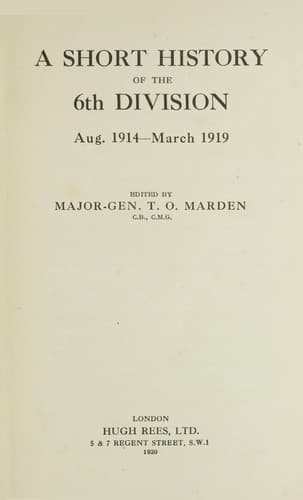
A Short History of the 6th Division: Aug. 1914-March 1919
History
A Short History of the 6th Division: Aug. 1914-March 1919
Great Britain. Army. Division, 6th; World War, 1914-1918 -- Campaigns -- Western Front; World War, 1914-1918 -- Regimental histories -- Great Britain
THE MARCH TO THE RHINE AND OCCUPATION OF GERMANY
1918-19
Armistice Day--11th November--found the Division in billets in Bohain
area, training for possible future operations. The news of the
cessation of hostilities was received with calm satisfaction that we
had beaten the Germans, and of relief that now we could sleep
peacefully at nights and that lights need not be screened.
Early in November the 1st and 32nd Divisions of the IX Corps had
forced the crossings of the Sambre Canal at Catillon and Ors after
heavy fighting, and had driven the enemy back towards Avesnes. On 11th
November a mixed force, under Major-Gen. Bethell, was pushing the
disorganized Germans over the Belgian frontier near Beaumont.
The IX Corps was now transferred to the Second Army, under Gen. Sir H.
Plumer, to whom was assigned the command of the British Army of
Occupation in Germany.
On leaving the Fourth Army the following letter, addressed personally
to the Divisional Commander, was received from Gen. Sir Henry
Rawlinson:--
"Now that the 6th Division is passing to the command of another Army,
I desire to place on record my sincere appreciation and warm thanks
for the valuable services rendered by you since you joined the Fourth
Army in September last.
"The Division has passed through strenuous times and has seen some
heavy fighting, especially in September between Holnon Wood and the
Canal, and at Bohain and Vaux Andigny in October, where the gallantry
and determination of all ranks filled me with admiration.
"I congratulate most heartily you all on the victories you have
won, and trust that at some future time I may again find the Division
under my command."
The Division spent the period 14th to 19th November in a march, via
Catillon and Avesnes, to the area round Solre le Chateau and Sars
Poteries, where it was to assemble for the March to the Rhine. For
this it was organized in three Infantry Brigade Groups and a
Divisional Troops Group under the C.R.A. The 16th Army R.H.A. Brigade
(Chestnut Troop, "Q" and "U" Batteries) was attached to the Division,
and formed part of the 18th Infantry Brigade Group. The 2nd Brigade,
R.F.A., marched with the Divisional Troops Column, the 24th Brigade,
R.F.A., with the 71st Infantry Brigade, and the Divisional Ammunition
Column with the 16th Infantry Brigade. Each Infantry Brigade had a
Field Company and Field Ambulance.
The march resembled the progression of a snake, the rear group moving
forward at each advance to the area occupied the previous day by the
leading group. Commencing officially on the 20th November there were
long halts up to 2nd December, owing to the difficulty of feeding the
leading Divisions (cavalry and infantry), caused by the destruction
done by the Germans to the railways, and also owing to the withdrawal
of the Germans not being carried out in accordance with programme.
Sometimes groups did not move, or only made minor adjustments to
obtain more comfortable quarters.
Public-domain text, read in full here on John Shaqi.
Reviews
Reviews
No reviews yet
Be the first to share your thoughts on this work.
Elsewhere in the archive
Join the Discussion
Join the discussion
Sign in to leave a comment or review.
Sign InorCreate an account