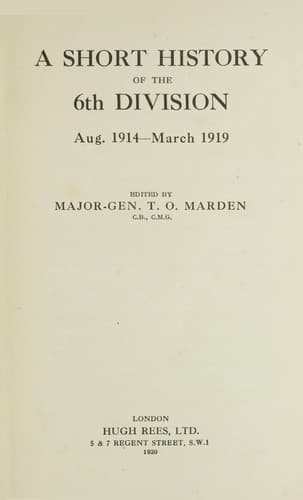
A Short History of the 6th Division: Aug. 1914-March 1919
History
A Short History of the 6th Division: Aug. 1914-March 1919
Great Britain. Army. Division, 6th; World War, 1914-1918 -- Campaigns -- Western Front; World War, 1914-1918 -- Regimental histories -- Great Britain
Both branches of the staff had long days of reconnaissance in cars
ahead of the Division, made to avoid moving troops farther off the
main roads than necessary, while the R.E. and Pioneers were often
pushed ahead to see about water supplies and mend roads. Up to the
Belgian frontier roads had been cratered and bridges blown down, and
these caused defiles and impeded the march. Once across the frontier
the roads were splendid, the inhabitants most hospitable and
enthusiastic, and the advance only held up until it could be
pushed through continuously.
However, it was no hardship to be delayed in such charming
surroundings, though the weather was for the most part vile. The march
from the neighbourhood of Dinant across the Ardennes, and along the
lovely valley of the River Ambleve, will always stand out as a most
delightful reminiscence. All ranks worked hard at their equipment, and
the transport was so smart as to be thought by the Belgians to be new.
It was a proud and splendid Division which marched, with drums beating
and colours flying, across the German frontier into the little town of
Malmedy between 13th and 16th December.
Marching generally by only one road, the length of the Division, when
billeted, varied from ten to twenty-five miles. It was particularly
interesting for Brigades to occupy the German huts at Elsenborn Camp
of Exercise, where large numbers of the enemy had assembled in the end
of July 1914 for the conquest of Belgium.
The attitude of the population in Germany was servile, and little hate
could be felt by one or two battalions which marched into Malmedy in
pouring rain and found German women lighting special fires, without
being ordered to do so, to dry their clothing. It must, however, be
added that the inhabitants of Malmedy speak French and have Belgian
sympathies.
Passing through the lovely little village of Montjoie, which reminds
one so much of Switzerland, the Division marched to its allotted area
south-west of Cologne, Divisional Headquarters arriving at Bruhl, six
miles from Cologne, on Christmas Eve; Headquarters 16th Infantry
Brigade at Zulpich, Headquarters 18th Infantry Brigade at Lechenich,
Headquarters 71st Infantry Brigade at Eichhols (a country house), and
Headquarters Divisional Troops at a chateau near Weilerswist. The
route followed--220 miles--is given in the Diary.
It was with a great feeling of gratitude and elation that the
Division ate their Christmas dinner on the Rhine in December 1918.
The area allotted to the Division was a strip of country almost
rectangular in shape, with a maximum length of twenty miles, and a
maximum breadth of twelve miles, and lying to the immediate south-west
of Cologne. The north-west border was on the ring of forts encircling
the city, which were later included in the divisional area.
Public-domain text, read in full here on John Shaqi.
Reviews
Reviews
No reviews yet
Be the first to share your thoughts on this work.
Elsewhere in the archive
Join the Discussion
Join the discussion
Sign in to leave a comment or review.
Sign InorCreate an account