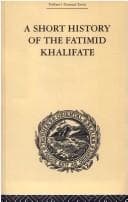
A Short History of the Fatimid Khalifate — John Shaqi
A Short History of the Fatimid KhalifateO'Leary, De Lacy
History
A Short History of the Fatimid Khalifate
O'Leary, De Lacy
Egypt -- History -- 640-1250; Egypt -- Kings and rulers; Fatimites -- History
In order to make proselytes, ʿAbdullah’s missionaries used to propose
obscure questions about the Qurʾan and the doctrines of traditional
Islam, with the object of showing that as generally held these doctrines
were contrary to reason, and so required an explanation. The revelation
of Islam, they said, was difficult, and hence there was much diversity
of opinion and many sects and schools of thought, all of which caused
an infinite amount of disedification and much trouble. The reason of
these diverse opinions is that each man follows his own private judgment
and forms his own conjectures, with the result that many end in utter
unbelief. But God would not give a revelation full of such obscurity
and ambiguity as the only guidance for men. It must be that there is
some available guidance, some authoritative teacher who can explain the
doctrine so that it may be both clear and certain, and such an infallible
teacher implies an Imam. The _daʿi_ then gave illustrations of the
obscurities and difficulties which men are not able to understand by the
light of their own reason. The pilgrims at Mecca throw stones and run
between the two hills, Safa and Merwa,—what is the purpose and meaning of
this? Why is it that a woman who has omitted a fast and prayer because
prevented by reasons of personal impurity is required to fast afterwards
to make up for her omission, but is not required to make up for the
omitted prayer? Why did God take six days to create the world when he
could quite well have created it in an hour? What does the Qurʾan mean
when he refers in a figurative manner to the “way”? What is the meaning
of the reference to the two angels who write and take note?—why cannot
we see them? What really are the torments of hell? What mean the words
“and over them on that day eight shall bear up the throne of thy Lord”?
(Qur., 69, 17). What is Iblis?—Who are Yajuj and Majuj (Qur., 18, 93),
and Harut and Marut (Qur., 2, 96)? Why have there been created seven
heavens, and seven earths, and why are there seven verses in the Fatha?
and many similar questions all designed to show that the Qurʾan is full
of references to things which are not explained and need explaining, but
to which the orthodox teachers are unable to give an explanation. All
these are the conventional arguments which are commonly employed to prove
that revelation is incomplete without an authorised teacher.
Public-domain text, read in full here on John Shaqi.
Reviews
Reviews
No reviews yet
Be the first to share your thoughts on this work.
Join the Discussion
Join the discussion
Sign in to leave a comment or review.
Sign InorCreate an account