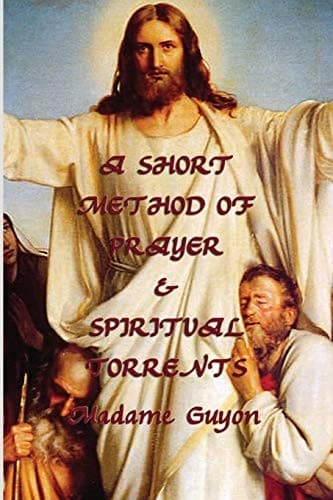
A Short Method of PrayerGuyon, Jeanne Marie Bouvier de la Motte
Religion
A Short Method of Prayer
Guyon, Jeanne Marie Bouvier de la Motte
Prayer -- Christianity
Practically it should be a continual loss of our own will in the will
of God, a renunciation of all natural inclinations, however good they
may appear, in order that we may be left free to choose only as God
chooses: we should be indifferent to all things, whether temporal or
spiritual, for the body or the soul; leaving the past in forgetfulness,
the future to providence, and giving the present to God; contented with
the present moment, which brings with it God's eternal will for us;
attributing nothing which happens to us to the creature, but seeing all
things in God, and regarding them as coming infallibly from His hand,
with the exception only of our own sin.
Leave yourselves, then, to be guided by God as He will, whether as
regards the inner or the outward life.
CHAPTER VI.
OF SUFFERING WHICH MUST BE ACCEPTED AS FROM GOD--ITS FRUITS.
Be content with all the suffering that God may lay upon you. If you will
love Him purely, you will be as willing to follow Him to Calvary as to
Tabor.
He must be loved as much on Calvary as on Tabor, since it is there that
He makes the greatest manifestation of His love.
Do not act, then, like those people who give themselves at one time, and
take themselves back at another. They give themselves to be caressed,
and take themselves back when they are crucified; or else they seek for
consolation in the creature.
You can only find consolation in the love of the cross and in complete
abandonment. He who has no love for the cross has no love for God (see
Matt. xvi. 24). It is impossible to love God without loving the cross;
and a heart which has learned to love the cross finds sweetness, joy,
and pleasure even in the bitterest things. "To the hungry soul every
bitter thing is sweet" (Prov. xxvii. 7), because it is as hungry for the
cross as it is hungry for God.
The cross gives God, and God gives the cross. Abandonment and the cross
go together. As soon as you are sensible that something is repugnant to
you which presents itself to you in the light of suffering, abandon
yourself at once to God for that very thing, and present yourself as a
sacrifice to Him: you will see that, when the cross comes, it will have
lost much of its weight, because you will desire it. This will not
prevent your being sensible of its weight. Some people imagine that it
is not suffering to feel the cross. The feeling of suffering is one of
the principal parts of suffering itself. Jesus Himself was willing to
suffer it in its intensity.
Often the cross is borne with weakness, at other times with strength:
all should be equal in the will of God.
CHAPTER VII.
ON MYSTERIES--GOD GIVES THEM HERE IN REALITY.
Public-domain text, read in full here on John Shaqi.
Reviews
Reviews
No reviews yet
Be the first to share your thoughts on this work.
Join the Discussion
Join the discussion
Sign in to leave a comment or review.
Sign InorCreate an account