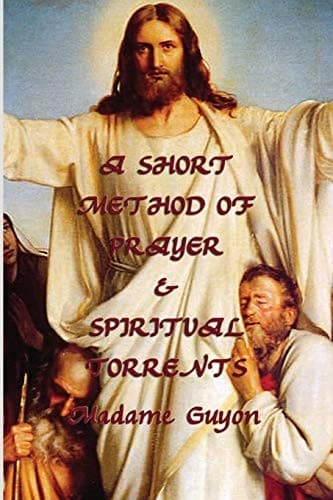
A Short Method of PrayerGuyon, Jeanne Marie Bouvier de la Motte
Religion
A Short Method of Prayer
Guyon, Jeanne Marie Bouvier de la Motte
Prayer -- Christianity
There are _passing_ and _distinct_ actions, and _continued_ actions;
_direct_ acts and _reflected_ acts. All cannot perform the first, and
all are not in a condition to perform the others. The first actions
should be committed by those who are turned away from God. They ought to
turn to Him by a distinct action, more or less strong according to their
distance from Him.
By a _continued_ action I understand that by which the soul is
completely turned towards its God by a _direct_ action, which it does
not renew, unless it has been interrupted, but which exists. The soul
being altogether turned in this way, is in love, and remains there: "And
he that dwelleth in love, dwelleth in God" (1 John iv. 16). Then the
soul may be said to be in a habitual act, resting even in this action.
But its rest is not idle, for it has an action _always in force_, viz.,
_a gentle sinking in God_, in which God attracts it more and more
strongly; and, following this attraction, and resting in love, it sinks
more and more in this love, and has an action infinitely stronger, more
vigorous, and more prompt, than that action which forms only the return.
Now the soul which is in this _profound and strong action_, being turned
towards its God, does not perceive this action, because it is direct,
and not reflex; so that persons in this condition, not knowing how
rightly to describe it, say that _they have no action_. But they are
mistaken; they were never more active. It would be better to say they do
not distinguish any action, than that they do not commit any.
The soul does not act of itself, I admit; but it is drawn, and it
follows the attracting power. Love is the weight which sinks it, as a
person who falls in the sea sinks, and would sink to infinity if the sea
were infinite; and without perceiving its sinking, it would sink to the
most profound depths with an incredible speed. It is, then, incorrect to
say that no actions are committed. All commit actions, but all do not
commit them in the same manner; and the abuse arises from the fact, that
those who know that action is inevitable wish it to be _distinct_ and
_sensible_. But sensible action is for beginners, and the other for
those more advanced. To stop with the first would be to deprive
ourselves of the last; and to wish to commit the last before having
passed the first would be an equal abuse.
Everything must be done in its season; each state has its commencement,
its progress, and its end. There is no act which has not its beginning.
At first we must work with _effort_, but afterwards we enjoy the fruit
of our labour.
Public-domain text, read in full here on John Shaqi.
Reviews
Reviews
No reviews yet
Be the first to share your thoughts on this work.
Join the Discussion
Join the discussion
Sign in to leave a comment or review.
Sign InorCreate an account