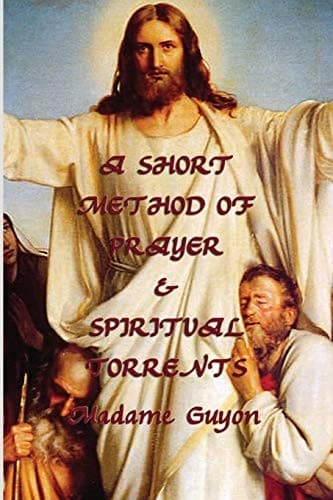
A Short Method of PrayerGuyon, Jeanne Marie Bouvier de la Motte
Religion
A Short Method of Prayer
Guyon, Jeanne Marie Bouvier de la Motte
Prayer -- Christianity
It will be objected to this, that God never deprives man of his liberty,
and that therefore he can always resist God; for which reason I ought
not to say that _God acts absolutely, without the consent of man_. In
explanation I say, that it is sufficient that man should give a
_passive consent_, that he may have entire and full liberty; because
having at the beginning given himself to God, that He may do as He will
both with him and in him, he gave from that time an _active_ and general
assent to all that God might do. But when God destroys, burns, and
purifies, the soul does not see that all this is for its advantage; it
rather believes the contrary: and as at first the fire seems to tarnish
the gold, so this operation seems to despoil the soul of its purity. So
that if an _active_ and _explicit_ consent were required, the soul would
find a difficulty in giving it, and often would not give it. All that it
does is to remain in a passive contentment, enduring this operation as
well as it can, being neither able nor willing to prevent it.
God then so purifies this soul of all natural, distinct, and perceived
operations, that at last He makes it more and more _conformed_ to
Himself, and then _uniform_, raising the passive capacity of the
creature, enlarging it and ennobling it, though in a hidden and
unperceived manner, which is termed mystical. But in all these
operations the soul must concur passively, and in proportion as the
working of God becomes stronger, the soul must continually yield to Him,
until He absorbs it altogether. We do not say, then, as some assert,
that there must be no _action_; since, on the contrary, this is _the
door_; but only that _we must not remain in it_, seeing that man should
tend towards the perfection of his end, and that he can never reach it
without quitting the first means, which, though they were necessary to
introduce him into the way, would greatly hinder him afterwards, if he
attached himself obstinately to them. This is what Paul said, "I forget
those things which are behind, and reach forth unto those things which
are before; I press toward the mark" (Phil. iii. 13, 14).
Should we not consider a person destitute of reason who, after
undertaking a journey, stopped at the first inn, because he was assured
that several had passed it, that a few had lodged there, and that the
landlord lived there? What the soul is required to do, then, is _to
advance towards its end_, to take the shortest road, not to stop at the
first point, and, following the advice of St Paul, to suffer itself to
be "led by the Spirit of God" (Rom. viii. 14), who will lead it to the
end for which it was created, which is the enjoyment of God.
Public-domain text, read in full here on John Shaqi.
Reviews
Reviews
No reviews yet
Be the first to share your thoughts on this work.
Join the Discussion
Join the discussion
Sign in to leave a comment or review.
Sign InorCreate an account