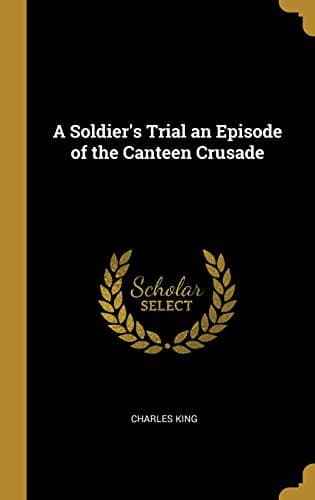
A Soldier's Trial: An Episode of the Canteen CrusadeKing, Charles
General
A Soldier's Trial: An Episode of the Canteen Crusade
King, Charles
United States. Army -- Military life -- Fiction
Then another thing happened, almost whimsical in the way of retributive
justice where Mrs. Ray's relatives were concerned. That the resultant
burden should have been saddled on her cavalry husband was perhaps not
quite so diverting. There were several of Mrs. Ray's nearest of kin who
had by no means approved of her marriage in the army, and to a nameless,
moneyless subaltern at that. "He will make ducks and drakes of her
fortune," said they. "He will drink and gamble it away," said certain
others. Ray had possibly heard, had probably expected this. At all
events he had steadfastly declined to use his wife's money. He had gone
so far as to grieve her not a little by very gently, but very firmly,
declining to undertake the management of her property. That was all left
in the hands of her people. It was the agent of their choice who made
ducks and drakes of much of it, as well as of their own, and, at the
time the Spanish War broke out, from his pay as major in the line of the
army "Billy" Ray was contributing to the support of certain of the
children of his former detractors.
Then came partial relief. "Sandy" Ray, their eldest son, commissioned
like his father in the cavalry, was no longer to be provided for.
Indeed, he was sending every month a certain quarter of his salary
direct to his mother to repay her for moneys advanced for him when they
were much needed. Maidie Ray, their lovely dark-eyed daughter, had
married the man of her choice, a well-to-do young New Yorker of most
excellent family. There was only Billy, Junior, among their olive
branches now to be provided for until he could look out for himself.
There was even prospect of his being sent to West Point within the year
to make a try at that which had proved too hard a problem for his
unmathematical elder brother, for Sandy had worn cadet gray long enough
to get much of the practical teaching of our famous school, though he
could not assimilate the requisite amount of the theoretical. It was the
year after the surrender of Santiago and the muster out of most of the
State volunteers that, in the goodness of his heart, Colonel Ray turned
to Marion, his wife, and said:
"Why not have Beth and 'Cilla come to us?"--and thereby hangs very much
of this tale.
Public-domain text, read in full here on John Shaqi.
Reviews
Reviews
No reviews yet
Be the first to share your thoughts on this work.
Join the Discussion
Join the discussion
Sign in to leave a comment or review.
Sign InorCreate an account