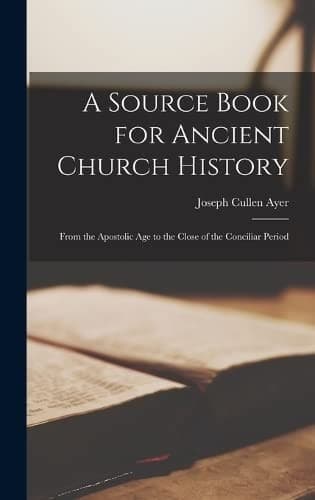
A Source Book for Ancient Church History — John Shaqi
A Source Book for Ancient Church HistoryAyer, Joseph Cullen
History
A Source Book for Ancient Church History
Ayer, Joseph Cullen
Church history -- Primitive and early church, ca. 30-600 -- Sources
The principal sources for the history of the Church in this period are the
books of the New Testament, and only to a slight degree the works of
contemporaneous Jewish and heathen writers. It is hardly necessary to
reproduce New Testament passages here. The Jewish references of importance
will be found in the works on the life of Christ and of St. Paul. As the
treatment of this period commonly falls under a different branch of study,
New Testament exegesis, it is not necessary in Church history to enter
into any detail. There are, however, a few references to events in this
period which are to be found only outside the New Testament, and are of
importance to the student of Church history. These are the Neronian
persecution (§ 1), the death of the Apostles (§§ 2, 3), and the
persecution under Domitian (§ 4). The paucity of references to
Christianity in the first century is due chiefly to the fact that
Christianity appeared to the men of the times as merely a very small
Oriental religion, struggling for recognition, and contending with many
others coming from the same region. It had not yet made any great advance
either in numbers or social importance.
§ 1. The Neronian Persecution
The Neronian persecution took place A. D. 64. The occasion was the great
fire which destroyed a large part of the city of Rome. To turn public
suspicion from himself as responsible for the fire, Nero attempted to make
the Christians appear as the incendiaries. Many were put to death in
horrible and fantastic ways. It was not, however, a persecution directed
against Christianity as an unlawful religion. It was probably confined to
Rome and at most the immediate vicinity, and there is no evidence that it
was a general persecution.
Additional source material: Lactantius, _De Mortibus Persecutorum_, ch. 2
(ANF, VII); Sulpicius Severus, Chronicon, II. 28 (PNF, ser. II, vol. XI).
(_a_) Tacitus, _Annales_, XV, 44. Preuschen, _Analecta_, I, § 3:1. Mirbt,
n. 3.
Tacitus (c. 52-c. 117), although not an eye-witness of the
persecution, had exceptionally good opportunities for obtaining
accurate information, and his account is entirely trustworthy. He
is the principal source for the persecution.
Public-domain text, read in full here on John Shaqi.
Reviews
Reviews
No reviews yet
Be the first to share your thoughts on this work.
Join the Discussion
Join the discussion
Sign in to leave a comment or review.
Sign InorCreate an account