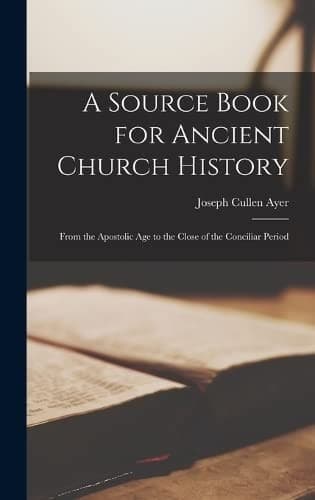
A Source Book for Ancient Church HistoryAyer, Joseph Cullen
History
A Source Book for Ancient Church History
Ayer, Joseph Cullen
Church history -- Primitive and early church, ca. 30-600 -- Sources
Ch. 5. But to leave the ancient examples, let us come to the champions who
lived nearest our times; let us take the noble examples of our generation.
On account of jealousy and envy the greatest and most righteous pillars of
the Church were persecuted, and contended even unto death. Let us set
before our eyes the good Apostles: Peter, who on account of unrighteous
jealousy endured not one nor two, but many sufferings, and so, having
borne his testimony, went to his deserved place of glory. On account of
jealousy and strife Paul pointed out the prize of endurance. After he had
been seven times in bonds, had been driven into exile, had been stoned,
had been a preacher in the East and in the West, he received the noble
reward of his faith; having taught righteousness unto the whole world, and
having come to the farthest bounds of the West, and having borne witness
before rulers, he thus departed from the world and went unto the holy
place, having become a notable pattern of patient endurance.
Ch. 6. Unto these men who lived lives of holiness was gathered a vast
multitude of the elect, who by many indignities and tortures, being the
victims of jealousy, set the finest examples among us. On account of
jealousy women, when they had been persecuted as Danaïds and Dircæ, and
had suffered cruel and unholy insults, safely reached the goal in the race
of faith and received a noble reward, feeble though they were in body.
§ 2. The Death of Peter and Paul
Eusebius, _Hist. Ec._, II, 25. (MSG, 20:207.) _Cf._ Mirbt, n. 33.
For an examination of the merits of Eusebius as a historian, see
McGiffert’s edition, PNF, ser. II, vol. I, pp. 45-52; also J. B.
Lightfoot, art. “Eusebius (23) of Caesarea,” in DCB.
The works of Caius have been preserved only in fragments; see
Krüger, § 90. If he was a contemporary of Zephyrinus, he probably
lived during the pontificate of that bishop of Rome, 199-217 A. D.
The Phrygian heresy which Caius combated was Montanism; see below,
§ 25.
Dionysius, Bishop of Corinth, was a contemporary of Soter, Bishop
of Rome, 166-174 A. D., whom he mentions in an epistle to the
Roman Church. Of his epistles only fragments have been preserved;
see Krüger, § 55. The following extract from his epistle to the
Roman Church is the earliest explicit statement that Peter and
Paul suffered martyrdom at the same time or that Peter was ever in
Italy. In connection with this extract, that from Clement of Rome
(see § 1, _a_) should be consulted; also Lactantius, _De Mortibus
Persecutorum_, ch. 2 (ANF).
Public-domain text, read in full here on John Shaqi.
Reviews
Reviews
No reviews yet
Be the first to share your thoughts on this work.
Join the Discussion
Join the discussion
Sign in to leave a comment or review.
Sign InorCreate an account