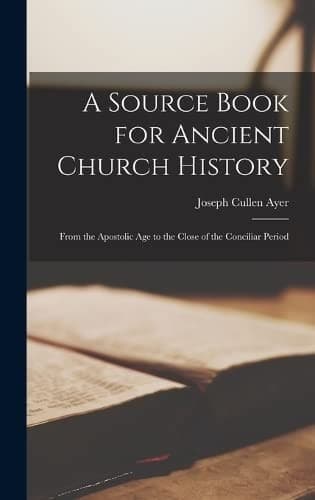
A Source Book for Ancient Church HistoryAyer, Joseph Cullen
History
A Source Book for Ancient Church History
Ayer, Joseph Cullen
Church history -- Primitive and early church, ca. 30-600 -- Sources
Ch. 5. The remedies for propitiating God are given in the words of God
himself. The divine instructions have taught sinners what they ought to
do; that by works of righteousness God is satisfied, and with the merits
of mercy sins are cleansed.… He [the angel Raphael, _cf._ Tobit. 12:8, 9]
shows that our prayers and fastings are of little avail unless they are
aided by almsgiving; that entreaties alone are of little force to obtain
what they seek, unless they be made sufficient by the addition of deeds
and good works. The angel reveals and manifests and certifies that our
petitions become efficacious by almsgiving, that life is redeemed from
dangers by almsgiving, that souls are delivered from death by almsgiving.
§ 40. The Monarchian Controversies
Monarchianism is a general term used to include all the unsuccessful
attempts of teachers within the Church to explain the divine element in
Christ without doing violence to the doctrine of the unity of God, and yet
without employing the Logos christology. These attempts were made chiefly
between the latter part of the second century and the end of the third.
They fall into classes accordingly as they regard the divine element in
Christ as personal or impersonal. One class makes the divine element to be
an impersonal power (Greek, dynamis) sent from God into the man Jesus;
hence the term “Dynamistic Monarchians.” The other class makes the divine
element a person, without, however, making any personal distinction
between Father and Son, only a difference in the mode in which the one
divine person manifests Himself; hence the term “Modalistic Monarchians.”
By some the Dynamistic Monarchians have been called Adoptionists, because
they generally taught that the man Jesus ultimately became the Son of God,
not being such by nature but by “adoption.” The name Adoptionist has been
so long applied to a heresy of the eighth century, chiefly in Spain, that
it leads to confusion to use the term in connection with Monarchianism.
Furthermore, to speak of them as Dynamistic Monarchians groups them with
other Monarchians, which is desirable. The most important school of
Modalistic Monarchians was that of Sabellius, in which the Modalistic
principle was developed so as to include the three persons of the Trinity.
The sources may be found collected and annotated in Hilgenfeld,
_Ketsergeschichte_.
(A) Dynamistic Monarchianism
(_a_) Hippolytus, _Refut._, VII, 35, 36. (MSG, 16:3342.)
Public-domain text, read in full here on John Shaqi.
Reviews
Reviews
No reviews yet
Be the first to share your thoughts on this work.
Elsewhere in the archive
Join the Discussion
Join the discussion
Sign in to leave a comment or review.
Sign InorCreate an account