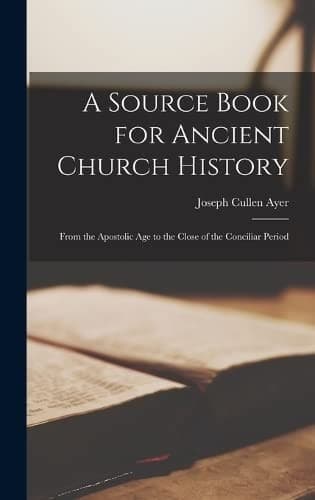
A Source Book for Ancient Church HistoryAyer, Joseph Cullen
History
A Source Book for Ancient Church History
Ayer, Joseph Cullen
Church history -- Primitive and early church, ca. 30-600 -- Sources
Ch. 35. A certain Theodotus, a native of Byzantium, introduced a novel
heresy, saying some things concerning the origin of the universe partly in
keeping with the doctrines of the true Church, in so far as he admits that
all things were created by God. Forcibly appropriating, however, his idea
of Christ from the Gnostics and from Cerinthus and Ebion, he alleges that
He appeared somewhat as follows: that Jesus was a man, born of a virgin,
according to the counsel of the Father, and that after He had lived in a
way common to all men, and had become pre-eminently religious, He
afterward at His baptism in Jordan received Christ, who came from above
and descended upon Him. Therefore miraculous powers did not operate within
Him prior to the manifestation of that Spirit which descended and
proclaimed Him as the Christ. But some [_i.e._, among the followers of
Theodotus] are disposed to think that this man never was God, even at the
descent of the Spirit; whereas others maintain that He was made God after
the resurrection from the dead.
Ch. 36. While, however, different questions have arisen among them, a
certain one named Theodotus, by trade a money-changer [to be distinguished
from the other Theodotus, who is commonly spoken of as Theodotus, the
leather-worker], attempted to establish the doctrine that a certain
Melchizedek is the greatest power, and that this one is greater than
Christ. And they allege that Christ happens to be according to the
likeness of this one. And they themselves, similarly with those who have
been previously spoken of as adherents of Theodotus, assert that Jesus is
a mere man, and that in conformity with the same account, Christ descended
upon Him.
(_b_) _The Little Labyrinth_, in Eusebius, _Hist. Ec._, V, 28. (MSG,
20:511.)
The author of _The Little Labyrinth_, a work from which Eusebius
quotes at considerable length, is uncertain. It has been
attributed to Hippolytus.
Public-domain text, read in full here on John Shaqi.
Reviews
Reviews
No reviews yet
Be the first to share your thoughts on this work.
Elsewhere in the archive
Join the Discussion
Join the discussion
Sign in to leave a comment or review.
Sign InorCreate an account