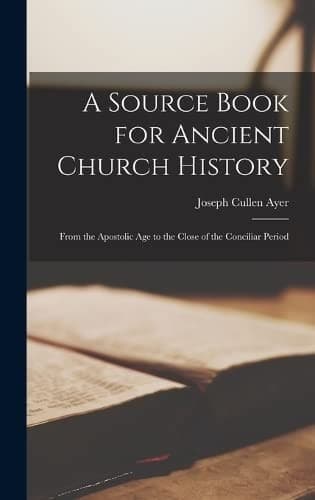
A Source Book for Ancient Church History — John Shaqi
A Source Book for Ancient Church HistoryAyer, Joseph Cullen
History
A Source Book for Ancient Church History
Ayer, Joseph Cullen
Church history -- Primitive and early church, ca. 30-600 -- Sources
To such a degree did the teaching of our faith flourish at that time(2)
that even those writers who were far from our religion did not hesitate to
mention in their histories the persecutions and martyrdoms which took
place during that time. And they, indeed, accurately indicate the time.
For they record that, in the fifteenth year of Domitian, Flavia Domitilla,
daughter of a sister of Flavius Clemens, who was at that time one of the
consuls of Rome, was exiled with many others to the island of Pontia(3) in
consequence of testimony borne to Christ.
Period II. The Post-Apostolic Age: A. D. 100-A. D. 140
The post-apostolic age, extending from circa 100 to circa 140, is the age
of the beginnings of Gentile Christianity on an extended scale. It is
marked by the rapid spread of Christianity, so that immediately after its
close the Church is found throughout the Roman world, and the Roman
Government is forced to take notice of it and deal with it as a religion
(§§ 6, 7); the decline of the Jewish element in the Church and extreme
hostility of Judaism to the Church (§ 5); the continuance of chiliastic
expectations (§ 10); the beginnings of the passion for martyrdom (§ 8); as
well as the appearance of the forms of organization and worship which
subsequently became greatly elaborated and remained permanently in the
Church (§§ 12-15); as also the appearance of religious and moral ideas
which became dominant in the ancient Church (§§ 11, 12, 16). The
literature of the period upon which the study of the conditions and
thought of the Church of this age must be based is represented principally
by the so-called Apostolic Fathers, a name which is convenient, but
misleading and to be regretted. These are Clement of Rome, Barnabas,
Ignatius, Polycarp, Papias, Hermas; with the writings of these are
commonly included two anonymous books known as the _Didache_, or _Teaching
of the Twelve Apostles_, and the _Epistle to Diognetus_. From all of these
selections are given.(4)
§ 5. Christianity and Judaism
The Christian Church grew up not on Jewish but on Gentile soil. In a very
short time the Gentiles formed the overwhelming majority within the
Church. As they did not become Jews and did not observe the Jewish
ceremonial law, a problem arose as to the place of the Jewish law, which
was accepted without question as of divine authority. One solution is
given by the author of the so-called Epistle of Barnabas, which should be
compared with the solution given by St. Paul in his epistles to the
Galatians and to the Romans. The number of conversions from Judaism
rapidly declined, and very early an extreme hostility toward Christianity
became common among the Jews.
(_a_) Barnabas, _Epistula_, 4, 9.
Public-domain text, read in full here on John Shaqi.
Reviews
Reviews
No reviews yet
Be the first to share your thoughts on this work.
Join the Discussion
Join the discussion
Sign in to leave a comment or review.
Sign InorCreate an account