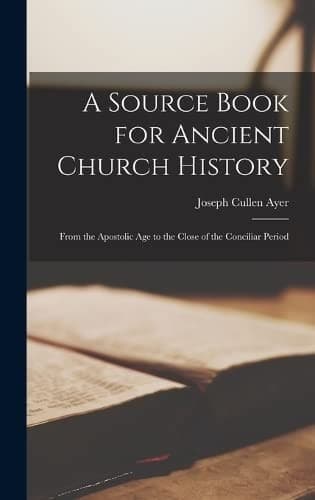
A Source Book for Ancient Church HistoryAyer, Joseph Cullen
History
A Source Book for Ancient Church History
Ayer, Joseph Cullen
Church history -- Primitive and early church, ca. 30-600 -- Sources
There is one Lord, only One from only One, God from God, the image and
likeness of the Godhead, the active Word, The Wisdom which comprehends the
constitution of all things, and the Power which produced all creation; the
true Son of the true Father, Invisible of Invisible, and Incorruptible of
Incorruptible, and Immortal of Immortal, and Everlasting of Everlasting.
And there is one Holy Spirit having His existence from God, and manifested
by the Son [namely, to men],(74) the perfect likeness of the perfect Son,
Life and Cause of the living [the sacred Fount], Sanctity, Leader of
sanctification, in whom is revealed God the Father, who is over all and in
all, and God the Son, who is through all; a perfect Trinity(75) not
divided nor differing in glory and eternity and sovereignty.
There is, therefore, nothing created or subservient in the Trinity, nor
introduced as if not there before, but coming afterward; for there never
was a time when the Son was lacking to the Father, nor the Spirit to the
Son, but the same Trinity is ever unvarying and unchangeable.
(_b_) Athanasius, _De Sent. Dionysii_, 4, 5, 6, 13-15. (MSG, 25:484 f.,
497 f.)
What has been called the “Controversy of the two Dionysii” was in
reality no controversy. Dionysius of Alexandria [_v. supra_, § 48]
wrote a letter to the Sabellians near Cyrene, pointing out the
distinction of the Father and the Son. In it he used language
which was, to say the least, indiscreet. Complaint was made to
Dionysius, bishop of Rome, that the bishop of Alexandria did not
hold the right view of the relation of the Son to the Father and
of the divinity of the Son. Thereupon, Dionysius of Rome wrote to
Dionysius of Alexandria. In reply, Dionysius of Alexandria pointed
out at length, in a _Refutation and Defence_, his actual opinion
on the matter as a whole, rather than as merely opposed to
Modalistic Monarchianism or Sabellianism. The course of the
discussion is sufficiently clear from the extracts. Athanasius is
writing in answer to the Arians, who had appealed to the letter of
Dionysius in support of their opinion that the Son was a creature,
and that there was when He was not [_v. infra_, § 63]. His work,
from which the following extracts are taken, was written between
350 and 354.
Ch. 4. They (the Arians) say, then, that in a letter the blessed Dionysius
has said: “The Son of God is a creature and made, and not His own by
nature, but in essence alien from the Father, just as the husbandman is
from the vine, or the shipbuilder is from the boat; for that, being a
creature, He was not before He came to be.” Yes. He wrote it, and we, too,
admit that such was his letter. But as he wrote this, so also he wrote
very many other epistles, which ought to be read by them, so that from all
and not from one merely the faith of the man might be discovered.
Public-domain text, read in full here on John Shaqi.
Reviews
Reviews
No reviews yet
Be the first to share your thoughts on this work.
Elsewhere in the archive
Join the Discussion
Join the discussion
Sign in to leave a comment or review.
Sign InorCreate an account