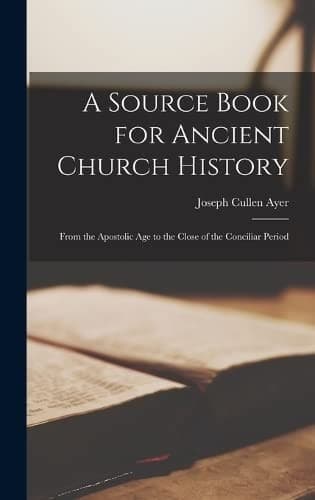
A Source Book for Ancient Church HistoryAyer, Joseph Cullen
History
A Source Book for Ancient Church History
Ayer, Joseph Cullen
Church history -- Primitive and early church, ca. 30-600 -- Sources
Ch. 5. At that time [_i.e._, when Dionysius wrote against the Sabellians]
certain of the bishops of Pentapolis in Upper Libya were of the opinion of
Sabellius. And they were so successful with their opinion that the Son of
God was scarcely preached any longer in the churches. Dionysius heard of
this, as he had charge of those churches (_cf._ Canon 6, Nicæa, 325; see
below, § 72), and sent men to counsel the guilty ones to cease from their
false doctrine. As they did not cease but waxed more shameless in their
impiety, he was compelled to meet their shameless conduct by writing the
said letter and to define from the Gospels the human nature of the
Saviour, in order that, since those men waxed bolder in denying the Son
and in ascribing His human actions to the Father, he accordingly, by
demonstrating that it was not the Father but the Son that was made man for
us, might persuade the ignorant persons that the Father is not the Son,
and so by degrees lead them to the true godhead of the Son and the
knowledge of the Father.
Ch. 6. … If in his writings he is inconsistent, let them [_i.e._, the
Arians] not draw him to their side, for on this assumption he is not
worthy of credit. But if, when he had written his letter to Ammonius, and
fallen under suspicion, he made his defence, bettering what he had said
previously, defending himself, but not changing, it must be evident that
he wrote what fell under suspicion by way of “accommodation.”
Ch. 13. The following is the occasion of his writing the other letters.
When Bishop Dionysius had heard of the affairs in Pentapolis and had
written in zeal for religion, as I have said, his letter to Euphranor and
Ammonius against the heresy of Sabellius, some of the brethren belonging
to the Church, who held a right opinion, but did not ask him so as to
learn from himself what he had written, went up to Rome and spake against
him in the presence of his namesake, Dionysius, bishop of Rome. And the
latter, upon hearing it, wrote simultaneously against the adherents of
Sabellius and against those who held the same opinions for uttering which
Arius was cast out of the Church; and he called it an equal and opposite
impiety to hold with Sabellius or with those who say that the Word of God
is a creature, framed and originated. And he wrote also to Dionysius
[_i.e._, of Alexandria] to inform him of what they had said about him. And
the latter straightway wrote back and inscribed a book entitled _A
Refutation and a Defence_.
Ch. 14. … In answer to these charges he writes, after certain prefatory
matter in the first book of the work entitled _A Refutation and a
Defence_, in the following terms:
Ch. 15. “For never was there a time when God was not a Father.” And this
he acknowledges in what follows, “that Christ is forever, being Word and
Wisdom and Power. For it is not to be supposed that God, having at first
no issue, afterward begat a Son. But the Son has his being not of Himself,
but of the Father.”
Public-domain text, read in full here on John Shaqi.
Reviews
Reviews
No reviews yet
Be the first to share your thoughts on this work.
Elsewhere in the archive
Join the Discussion
Join the discussion
Sign in to leave a comment or review.
Sign InorCreate an account