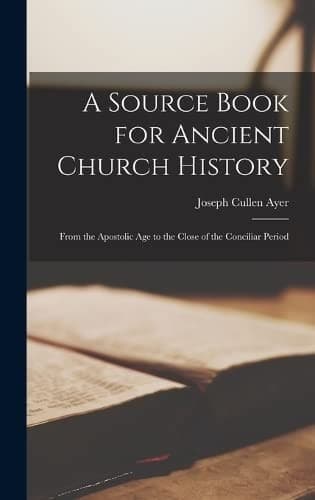
A Source Book for Ancient Church History — John Shaqi
A Source Book for Ancient Church HistoryAyer, Joseph Cullen
History
A Source Book for Ancient Church History
Ayer, Joseph Cullen
Church history -- Primitive and early church, ca. 30-600 -- Sources
Polycarp, Bishop of Smyrna, died at Smyrna February 2, 155, at the
age of at least eighty-six, but he was probably nearer one hundred
years old. He was the disciple of John, probably same as the
Apostle John. His epistle was written circa 115, soon after the
death of Ignatius of Antioch. At present it is generally regarded
as genuine, though grave doubts have been entertained in the past.
The martyrdom was written by some member of the church at Smyrna
for that body to send to the church at Philomelium in Phrygia, and
must have been composed soon after the death of the aged bishop.
It is probably the finest of all the ancient martyrdoms and should
be read in its entirety. Translation in the ANF, I, 37-45.
Ch. 12. The whole multitude both of the heathen and the Jews who dwelt at
Smyrna cried out with uncontrollable fury and in loud voice: “This is the
teacher of Asia, the father of the Christians and the overthrower of our
gods, who teaches many neither to sacrifice nor to worship.” Saying these
things, they cried out and demanded of Philip, the Asiarch, to let a lion
loose upon Polycarp. But he said he could not do this, since the sports
with beasts had ended. Then it pleased them to cry out with one consent
that he should burn Polycarp alive.…
Ch. 13. These things were carried into effect more rapidly than they were
spoken, and the multitude immediately gathered together wood and fagots
out of the shops and baths, and the Jews especially, as was their custom,
assisted them eagerly in it.
§ 6. The Extension of Christianity
It is impossible to determine with accuracy even the principal places to
which Christianity had spread in the first half of the second century.
Ancient writers were not infrequently led astray by their own rhetoric in
dealing with this topic.
Justin Martyr, _Dialogus cum Tryphone_, 117. (MSG, 6:676.)
The following passage is of significance as bearing not only upon
the extent to which Christianity had spread, after making due
allowance for rhetoric, but also upon the conception of the
eucharist and its relation to the ancient sacrifices held, by some
Christians at least, in the first half of the second century.
_Cf._ ch. 41 of the same work, _v. infra_, §§ 12 _f._
Public-domain text, read in full here on John Shaqi.
Reviews
Reviews
No reviews yet
Be the first to share your thoughts on this work.
Join the Discussion
Join the discussion
Sign in to leave a comment or review.
Sign InorCreate an account