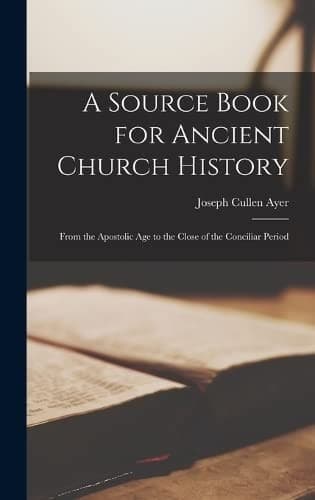
A Source Book for Ancient Church HistoryAyer, Joseph Cullen
History
A Source Book for Ancient Church History
Ayer, Joseph Cullen
Church history -- Primitive and early church, ca. 30-600 -- Sources
The Church’s cultus and sacramental system developed rapidly in the third
century. The beginnings of the administration of the sacraments according
to prescribed forms are to be traced to the Didache and Justin Martyr (see
above, §§ 13, 14). At the beginning of the third century baptism was
already accompanied by a series of subsidiary rites, and the eucharist was
regarded as a sacrifice, the benefit of which might be directed toward
specific ends. The further development was chiefly in connection with the
eucharist, which effected in turn the conception of the hierarchy (see
below, § 50). Baptism was regarded as conferring complete remission of
previous sins; subsequent sins were atoned for in the penitential
discipline (see above, § 42). As for the eucharist, the conception of the
sacrifice which appears in the Didache, an offering of praise and
thanksgiving, gradually gives place to a sacrifice which in some way
partakes of the nature of Christ’s sacrificial death upon the cross. At
the same time, the elements are more and more completely identified with
the body and blood of Christ, and the nature of the presence of Christ is
conceived under quasi-physical categories. As representatives of the lines
of development, Tertullian, at the beginning of the century, and Cyprian,
at the middle, may be taken. That a similar development took place in the
East is evident, not only from the references to the same in the writings
of Origen and others, but also from the appearance in the next century of
elaborate services, or liturgies, as well as the doctrinal statements of
writers generally.
(_a_) Tertullian, _De Corona_, 3. (MSL, 2:98.)
The ceremonies connected with baptism.
Public-domain text, read in full here on John Shaqi.
Reviews
Reviews
No reviews yet
Be the first to share your thoughts on this work.
Elsewhere in the archive
Join the Discussion
Join the discussion
Sign in to leave a comment or review.
Sign InorCreate an account