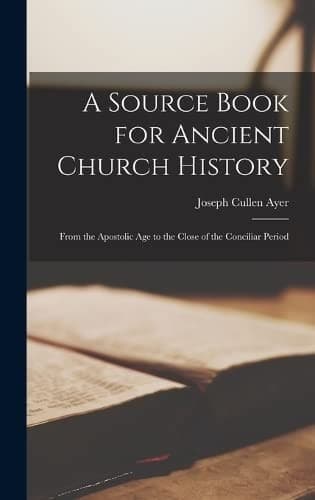
A Source Book for Ancient Church HistoryAyer, Joseph Cullen
History
A Source Book for Ancient Church History
Ayer, Joseph Cullen
Church history -- Primitive and early church, ca. 30-600 -- Sources
And how long shall we draw the saw to and fro through this line when we
have an ancient practice which by anticipation has settled the state of
the question? If no passage of Scripture has prescribed it, assuredly
custom, which without doubt flowed from tradition, has confirmed it. For
how can anything come into use if it has not first been handed down? Even
in pleading tradition written authority, you say, must be demanded. Let us
inquire, therefore, whether tradition, unless it be written, should not be
admitted. Certainly we shall say that it ought not to be admitted if no
cases of other practices which, without any written instrument, we
maintain on the ground of tradition alone, and the countenance thereafter
of custom, affords us any precedent. To deal with this matter briefly, I
shall begin with baptism. When we are going to enter the water, but a
little before, in the church and under the hand of the president, we
solemnly profess that we renounce the devil, and his pomp, and his angels.
Hereupon we are thrice immersed, making a somewhat ampler pledge than the
Lord has appointed in the Gospel. Then, when we are taken up (as new-born
children), we taste first of all a mixture of milk and honey; and from
that day we refrain from the daily bath for a whole week. We take also in
congregations, before daybreak, and from the hands of none but the
presidents, the sacrament of the eucharist, which the Lord both commanded
to be eaten at meal-times, and by all. On the anniversary day we make
offerings for the dead as birthday honors. We consider fasting on the
Lord’s Day to be unlawful, as also to worship kneeling. We rejoice in the
same privilege from Easter to Pentecost. We feel pained should any wine or
bread, even though our own, be cast upon the ground. At every forward step
and movement, at every going in and going out, when we put on our shoes,
at the bath, at table, on lighting the lamps, on couch, on seat, in all
the ordinary actions of daily life, we trace upon the forehead the sign
[_i.e._, of the cross].
(_b_) Tertullian, _De Baptismo_, 5-8. (MSL, 1:1314.)
The whole passage should be read as showing clearly that
Tertullian recognized the similarity between Christian baptism and
heathen purifying washings, but referred the effects of the
heathen rites to evil powers, quite in harmony with the Christian
admission of the reality of heathen divinities as evil powers and
heathen exorcisms as wrought by the aid of evil spirits.
Ch. 5. … Thus man will be restored by God to His likeness, for he formerly
had been after the image of God; the image is counted being in His form
[_in effigie_], the likeness in His eternity [_in æternitate_]. For he
receives that Spirit of God which he had then received from His afflatus,
but afterward lost through sin.
Ch. 6. Not that in the waters we obtain the Holy Spirit, but in the water,
under (the witness of angels) we are cleansed and prepared for the Holy
Spirit.…
Public-domain text, read in full here on John Shaqi.
Reviews
Reviews
No reviews yet
Be the first to share your thoughts on this work.
Elsewhere in the archive
Join the Discussion
Join the discussion
Sign in to leave a comment or review.
Sign InorCreate an account