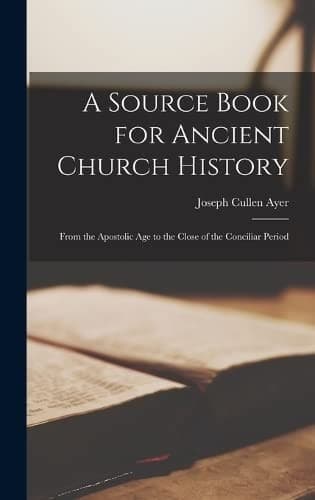
A Source Book for Ancient Church HistoryAyer, Joseph Cullen
History
A Source Book for Ancient Church History
Ayer, Joseph Cullen
Church history -- Primitive and early church, ca. 30-600 -- Sources
Ch. 7. After this, when we have issued from the font, we are thoroughly
anointed with a blessed unction according to the ancient discipline,
wherein on entering the priesthood men were accustomed to be anointed with
oil from a horn, wherefore Aaron was anointed by Moses.… Thus, too, in our
case the unction runs carnally, but profits spiritually; in the same way
as the act of baptism itself is carnal, in that we are plunged in the
water, but the effect spiritual, in that we are freed from sins.
Ch. 8. In the next place, the hand is laid upon us, invoking and inviting
the Holy Spirit through benediction.… But this, as well as the former, is
derived from the old sacramental rite in which Jacob blessed his grandsons
born of Joseph, Ephraim, and Manasses; with his hands laid on them and
interchanged, and indeed so transversely slanted the one over the other
that, by delineating Christ, they even portended the future benediction in
Christ. [_Cf._ Gen. 48:13 _f._]
(_c_) Cyprian, _Ep. ad Cæcilium, Ep. 63_, 13-17. (MSL, 4:395.)
The eucharist.
Thascius Cæcilius Cyprianus, bishop of Carthage, was born about
200, and became bishop in 248 or 249. His doctrinal position is a
development of that of Tertullian, beside whom he may be placed as
one of the founders of the characteristic theology of North
Africa. His discussion of the place and authority of the bishop in
the ecclesiastical system was of fundamental importance in the
development of the theory of the hierarchy, though it may be
questioned whether his particular theory of the relation of the
bishops to each other ever was realized in the Church. For his
course during the Decian persecution see §§ 45, 46. He died about
258, in the persecution under Valerian.
In the epistle from which the following extract is taken Cyprian
writes to Cæcilius to point out that it is wrong to use merely
water in the eucharist, and that wine mixed with water should be
used, for in all respects we do exactly what Christ did at the
Last Supper when he instituted the eucharist. In the course of the
letter, which is of some length, Cyprian takes occasion to set
forth his conception of the eucharistic sacrifice, which is a
distinct advance upon Tertullian. The date of the letter is about
253.
Public-domain text, read in full here on John Shaqi.
Reviews
Reviews
No reviews yet
Be the first to share your thoughts on this work.
Elsewhere in the archive
Join the Discussion
Join the discussion
Sign in to leave a comment or review.
Sign InorCreate an account