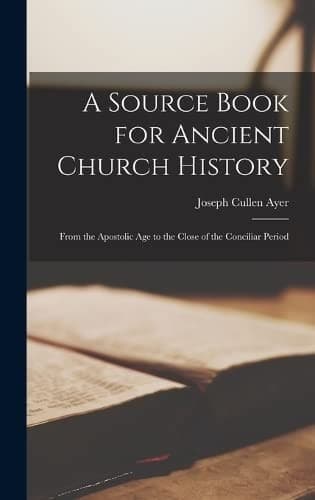
A Source Book for Ancient Church HistoryAyer, Joseph Cullen
History
A Source Book for Ancient Church History
Ayer, Joseph Cullen
Church history -- Primitive and early church, ca. 30-600 -- Sources
With your usual diligence you have consulted my poor intelligence, dearest
son, as to whether, among other heretics, they also who come from Novatian
ought, after his profane washing, to be baptized and sanctified in the
Catholic Church, with the lawful, true, and only baptism of the Church. In
answer to this question, as much as the capacity of my faith and the
sanctity and truth of the divine Scriptures suggest, I say that no
heretics and schismatics at all have any right to power. For which reason
Novatian, since he is without the Church and is acting in opposition to
the peace and love of Christ, neither ought to be, nor can be, omitted
from being counted among the adversaries and antichrists. For our Lord
Jesus Christ, when He declared in His Gospel that those who were not with
Him were His adversaries, did not point out any species of heresy, but
showed that all who were not with Him, and who were not gathering with
Him, were scattering His flock, and were His adversaries, saying: “He that
is not with me is against me, and he that gathereth not with me
scattereth” [Luke 11:23]. Moreover, the blessed Apostle John distinguished
no heresy or schism, neither did he set down any specially separated, but
he called all who had gone out from the Church, and who acted in
opposition to the Church, antichrists, saying, “Ye have heard that
Antichrist cometh, and even now are come many antichrists; wherefore we
know that this is the last time. They went out from us, but they were not
of us, for if they had been of us, they would have continued with us” [I
John 2:18 _f._]. Whence it appears that all are adversaries of the Lord
and are antichrists who are known to have departed from the charity and
from the unity of the Catholic Church.
§ 53. The Beginnings of Monasticism
Asceticism in some form is common to almost all religions. It was
practised extensively in early Christianity and ascetics of both sexes
were numerous. This asceticism, in addition to a life largely devoted to
prayer and fasting, was marked by refraining from marriage. But these
ascetics lived in close relations with those who were non-ascetics.
Monasticism is an advance upon this earlier asceticism in that it attempts
to create, apart from non-ascetics, a social order composed only of
ascetics in which the ascetic ideals may be more successfully realized.
The transition was made by the hermit life in which the ascetic lived
alone in deserts and other solitudes. This became monasticism by the union
of ascetics for mutual spiritual aid. This advance is associated with St.
Anthony. See also Pachomius, in § 77.
Additional source material: Pseudo-Clement. _De Virginitate_ (ANF,
VIII, 53); Methodius, _Symposium_ (ANF, VI, 309); the _Lausiac
History of Palladius_, E. C. Butler, _Texts and Studies_,
Cambridge, 1898; _Paradise, or Garden of the Holy Fathers_, trans.
by E. A. W. Budge, London, 1907.
Athanasius, _Vita S. Antonii_, 2-4, 44. (MSG, 26:844, 908.)
Public-domain text, read in full here on John Shaqi.
Reviews
Reviews
No reviews yet
Be the first to share your thoughts on this work.
Elsewhere in the archive
Join the Discussion
Join the discussion
Sign in to leave a comment or review.
Sign InorCreate an account