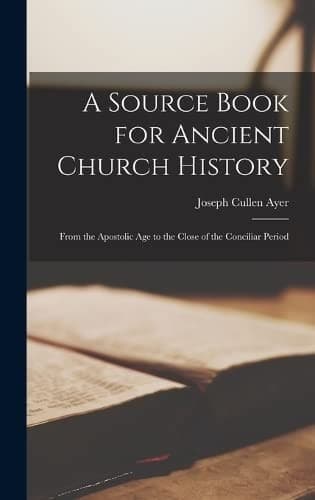
A Source Book for Ancient Church HistoryAyer, Joseph Cullen
History
A Source Book for Ancient Church History
Ayer, Joseph Cullen
Church history -- Primitive and early church, ca. 30-600 -- Sources
The Manichæans say: He first openly entered upon his work on the day when
Sapor, the son of Ardaschir, entered upon his reign, and placed the crown
upon his head; and this was Sunday, the first day of Nisan (March 20,
241), when the sun stood in the sign Aries. He was accompanied by two men,
who had already attached themselves to his religion; one was called
Simeon, the other Zakwa; besides these, his father accompanied him, to see
how his affairs would turn out.
Mani said he was the Paraclete, whom Jesus, of blessed memory,(85) had
previously announced. Mani took the elements of his doctrine from the
religion of the Magi and Christianity.… Before he met Sapor Mani had spent
about forty years in foreign lands.(86) Afterward he converted Peroz, the
brother of Sapor, and Peroz procured him an audience with his brother
Sapor. The Manichæans relate: He thereupon entered where he was and on his
shoulders were shining, as it were, two candles. When Sapor perceived him,
he was filled with reverence for him, and he appeared great in his eyes;
although he previously had determined to seize him and put him to death.
After he had met him, therefore, the fear of him filled him, he rejoiced
over him and asked him why he had come and promised to become his
disciple. Mani requested of him a number of things, among them that his
followers might be unmolested in the capital and in the other territories
of the Persian Empire, and that they might extend themselves whither they
wished in the provinces. Sapor granted him all he asked.
Mani had already preached in India, China, and among the inhabitants of
Turkestan, and in every land he left behind him disciples.(87)
(_b_) The Teaching of Mani.
The following extract from the same work gives but the beginning
of an extended statement of Mani’s teaching. But it is hoped that
enough is given to show the mythological character of his
speculation. The bulk of his doctrine was Persian and late
Babylonian, and the Christian element was very slight. It is clear
from the writings of St. Augustine that the doctrine changed much
in later years in the West.
The doctrine of Mani, especially his dogmas of the Eternal, to whom be
praise and glory, of the creation of the world and the contest between
Light and Darkness: Mani put at the beginning of the world two eternal
principles. Of these one is Light, the other Darkness. They are separated
from each other. As to the Light, this is the First, the Mighty One, and
the Infinite. He is the Deity, the King of the Paradise of Light. He has
five members or attributes, namely, gentleness, wisdom, understanding,
discretion, and insight; and further five members or attributes, namely,
love, faith, truth, bravery, and wisdom. He asserts that God was from all
eternity with these attributes. Together with the Light-God there are two
other things from eternity, the air and the earth.
Public-domain text, read in full here on John Shaqi.
Reviews
Reviews
No reviews yet
Be the first to share your thoughts on this work.
Elsewhere in the archive
Join the Discussion
Join the discussion
Sign in to leave a comment or review.
Sign InorCreate an account