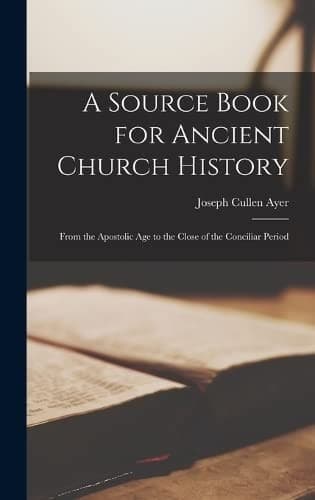
A Source Book for Ancient Church History — John Shaqi
A Source Book for Ancient Church HistoryAyer, Joseph Cullen
History
A Source Book for Ancient Church History
Ayer, Joseph Cullen
Church history -- Primitive and early church, ca. 30-600 -- Sources
So long as chiliastic expectations were the basis of the Christian’s hope
and his judgment of the order of this present world, the Christian felt
that he was but a stranger and sojourner in the world, and that his real
home was the kingdom of Christ, soon to be established here on earth. With
such a view the Christian would naturally define his relation to the world
as being in it, yet not of it. As time passed, the opinion became more
common that the kingdom of Christ was not a future world-order to be set
up on His return, but the Church here on earth. This thought, which is the
key to the _City of God_ by St. Augustine, was not to be found in the
first century and a half of the Church.
_Ep. ad Diognetum_, 5, 6.
The Epistle to Diognetus is one of the choicest pieces of
ante-Nicene literature. Although it is commonly included among the
Apostolic Fathers, the date is uncertain, it is anonymous, and the
reason for its inclusion is not clear. The weight of opinion is in
favor of an early date. It was preserved in but one manuscript,
which was unfortunately destroyed in 1870. The main themes of the
epistle are the faith and manners of the Christians, and an
attempt to explain the late appearance of Christianity in the
world. The work, therefore, is of the nature of an apology, and
should be compared with _The Apology of Aristides_. A translation
of the epistle may be found in ANF, I, 23.
Ch. 5. The Christians are distinguished from other men neither by country,
nor language, nor the customs which they observe. For they neither inhabit
cities of their own, nor employ a peculiar form of speech, nor lead a life
which is marked out by any singularity. The course of conduct which they
follow has not been devised by any speculation or deliberation of
inquisitive men; nor do they, like some, proclaim themselves the advocates
of any merely human doctrines. But, inhabiting Greek as well as barbarian
cities, according as the lot of each of them has been determined, and
following the customs of the natives in respect to clothing, food, and the
rest of their ordinary conduct, they display to us their wonderful and
confessedly striking method of life. They dwell in their own countries,
but simply as sojourners. As citizens, they share in all things with
others, and yet endure all things as if foreigners. Every foreign country
is to them as their native land, and every land of their birth as a land
of strangers. They marry as do all; they beget children; but they do not
commit abortion. They have a common table, but not a common bed. They are
in the flesh, but they do not live after the flesh. They pass their days
on earth, but they are the citizens of heaven. They obey the prescribed
laws, and at the same time surpass the laws by their lives. They love all
men, and are persecuted by all. They are unknown and condemned; they are
put to death and restored to life. They are poor, yet they make many rich;
Public-domain text, read in full here on John Shaqi.
Reviews
Reviews
No reviews yet
Be the first to share your thoughts on this work.
Join the Discussion
Join the discussion
Sign in to leave a comment or review.
Sign InorCreate an account