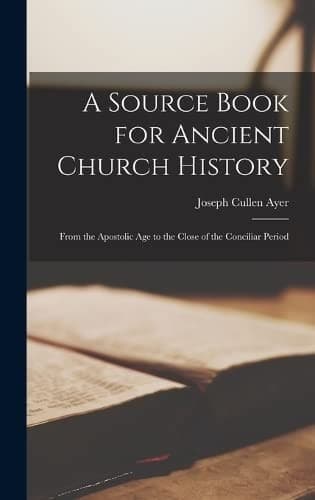
A Source Book for Ancient Church HistoryAyer, Joseph Cullen
History
A Source Book for Ancient Church History
Ayer, Joseph Cullen
Church history -- Primitive and early church, ca. 30-600 -- Sources
I think true culture consists not in proficiency in words and speech, but
in a condition of mind which has sound intentions and right opinions
concerning good and evil, the honorable and the base. Whoever, therefore,
thinks one thing and teaches those about him another appears to be as
wanting in culture as in honor. If in trifles there is a difference
between thought and speech, it is nevertheless an evil in some way to be
endured; but if in important matters any one thinks one thing and teaches
in opposition to what he thinks, this is the trick of charlatans, the act
not of good men, but of those who are thoroughly depraved, especially in
the case of those who teach what they regard as most worthless, deceiving
and enticing by flattery into evil those whom they wish to use for their
own purposes. All those who undertake to teach anything should be upright
in life and not cherish in their minds ideas which are in opposition to
those commonly received; most of all I think that such they ought to be
who converse with the young on learning, or who explain the writings of
the ancients, whether they are teachers of eloquence or of rhetoric, and
still more if they are sophists. For they aim to be not merely teachers of
words but of morals as well, and claim instruction in political science as
belonging to their field. Whether this be true, I will leave undetermined.
But praising them as those who thus strive for fine professions, I would
praise them still more if they neither lied nor contradicted themselves,
thinking one thing and teaching their pupils another. Homer, Hesiod,
Demosthenes, Herodotus, Thucydides, Isocrates, and Lysias were indebted to
the gods for all their science. Did they not think that they were under
the protection of Hermes and of the Muses? It seems to me, therefore,
absurd that those who explain their writings should despise the gods they
honored. But when I think it is absurd, I do not say that, on account of
their pupils, they should alter their opinions; but I give them the
choice, either not to teach what they do not hold as good, or, if they
prefer to teach, first to convince their pupils that Homer, Hesiod, or any
of those whom they explain and condemn, is not so godless and foolish in
respect to the gods as they represent him to be. For since they draw their
support and make gain from what these have written, they confess
themselves most sordidly greedy of gain, willing to do anything for a few
drachmas. Hitherto there were many causes for the lack of attendance upon
the temples, and overhanging fear gave an excuse for keeping secret the
right teaching concerning the gods. Now, however, since the gods have
granted us freedom, it seems to me absurd that men should teach what they
do not regard as good. If they believe that all those men are wise whose
writings they expound and as whose prophets they sit, let them first
imitate their piety toward the gods; but if they think that these writers
Public-domain text, read in full here on John Shaqi.
Reviews
Reviews
No reviews yet
Be the first to share your thoughts on this work.
Elsewhere in the archive
Join the Discussion
Join the discussion
Sign in to leave a comment or review.
Sign InorCreate an account