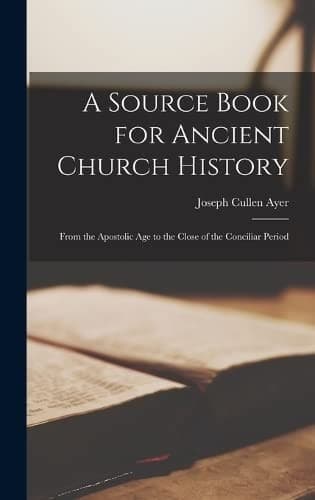
A Source Book for Ancient Church HistoryAyer, Joseph Cullen
History
A Source Book for Ancient Church History
Ayer, Joseph Cullen
Church history -- Primitive and early church, ca. 30-600 -- Sources
erred concerning the most honored gods, let them go into the churches of
the Galileans and expound Matthew and Luke, believing whom you forbid
attendance upon the sacrifices. I would that your ears and tongues were
born again, as you would say, of those things in which I always take part,
and whoever loves me thinks and does. This law is to apply to teachers and
instructors generally. Whoever among the youth wishes to make use of their
instruction is not forbidden. For it would not be fair in the case of
those who are yet youths and do not know which way to turn, to forbid the
best way, and through fear to compel them to remain unwillingly by their
ancestral institutions. Although it would be right to cure such people
against their wills as being insane, yet it is permitted all to suffer
under this disease. For it is my opinion that the ignorant should be
instructed, not punished.
Chapter III. The Triumph Of The New Nicene Orthodoxy Over Heterodoxy And
Heathenism
The Arian controversy was the most important series of events in the
internal history of the Christian Church in the fourth century, without
reference to the truth or error of the positions taken or the rightful
place of dogma within the Church. It roused more difficulties, problems,
and disputes, led to more persecutions, ended in greater party triumphs
than any other ecclesiastical or religious movement. It entered upon its
last important phase about the time of the accession of the Emperor
Julian. From that time the parties began to recognize their real
affiliations and sought a basis of union in a common principle. The effect
was that on the accession of Christian emperors the Church was able to
advance rapidly toward a definitive statement. Of the emperors that
followed Julian, Valentinian I (364-375), who ruled in the West, took a
moderate and tolerant position in the question regarding the existence of
heathenism alongside of the Church and heretical parties within the
Church, though afterward harsher measures were taken by his son and
successor (§ 69). In the East his colleague Valens (364-378) supported the
extreme Arian party and persecuted the other parties, at the same time
tolerating heathenism. This only brought the anti-Arians more closely
together as a new party on the basis of a new interpretation of the Nicene
formula (§ 70, _cf._ § 66, _c_). On the death of Valens at Adrianople,
378, an opportunity was given this new party, which it has become
customary to call the New Nicene party, to support Theodosius (379-395) in
his work of putting through the orthodox formula at the Council of
Constantinople, 381 (§ 71).
§ 69. The Emperors from Jovian to Theodosius and Their Policy toward
Heathenism and Arianism
Public-domain text, read in full here on John Shaqi.
Reviews
Reviews
No reviews yet
Be the first to share your thoughts on this work.
Elsewhere in the archive
Join the Discussion
Join the discussion
Sign in to leave a comment or review.
Sign InorCreate an account