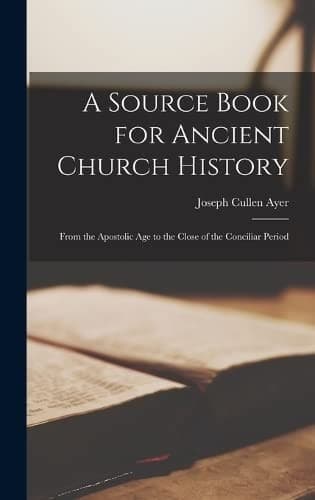
A Source Book for Ancient Church HistoryAyer, Joseph Cullen
History
A Source Book for Ancient Church History
Ayer, Joseph Cullen
Church history -- Primitive and early church, ca. 30-600 -- Sources
The reign of Jovian lasted so short a time, June, 363, to February, 364,
that he had no time to develop a policy, and the assertion of Theodoret
that he extinguished the heathen sacrificial fires is doubtful. On the
death of Jovian, Valentinian was elected Emperor, who soon associated with
himself his brother Valens as his colleague for the East. The two were
tolerant toward heathenism, but Valens took an active part in favor of
Arianism, while Valentinian held aloof from doctrinal controversy. On the
death of Valentinian I, his sons Gratian (murdered at Lyons, 383) and
Valentinian II (murdered at Vienne by Arbogast, 392), succeeded to the
Empire. Under them the policy of toleration ceased, heathenism was
proscribed. In the East under Theodosius, appointed colleague of Gratian
in 379, the same policy was enforced. Arianism was now put down with a
strong hand in both parts of the Empire.
(_a_) Ammianus Marcellinus, _Roman History_, XXX, 9, § 5.
The religious policy of Valentinian I.
Ammianus Marcellinus is probably the best of the later Roman
historians, and is the chief authority for much of the secular
history from 353 to 378, in which period he is a source of the
first rank, writing from personal observation and first-hand
information. Ammianus was himself a heathen, but he seems not to
have been embittered by the persecution to which his faith had
been subjected. He was a man of a calm and judicial mind, and his
judgment is rarely biassed, even when he touches upon
ecclesiastical matters which, however, he rarely does.
Valentinian was especially remarkable during his reign for his moderation
in this particular—that he kept a middle course between the different
sects of religion, and never troubled any one, nor issued any orders in
favor of one kind of worship rather than another; nor did he promulgate
any threatening edicts to bow down the necks of his subjects to the form
of worship to which he himself was inclined; but he left these parties
just as he found them, without making any alterations.
(_b_) _Codex Theodosianus_, XII, 1, 75; A. D. 371.
In this edict Valentinian I confirms the immunities of the heathen
priesthood which had been restored by Julian. The heathen
priesthood is here shown to continue as still open to aspirants
after political honors and conferring immunities upon those who
attained it. The curial had to pass through the various offices in
fixed order before he attained release from burdens which had been
laid upon him by the State’s system of taxation.
Public-domain text, read in full here on John Shaqi.
Reviews
Reviews
No reviews yet
Be the first to share your thoughts on this work.
Elsewhere in the archive
Join the Discussion
Join the discussion
Sign in to leave a comment or review.
Sign InorCreate an account