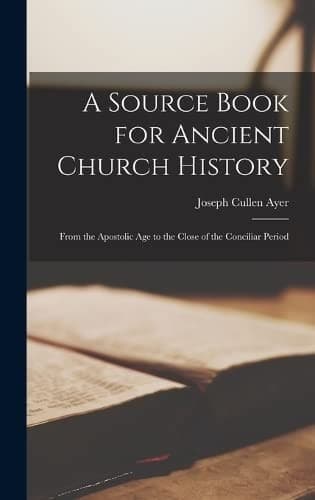
A Source Book for Ancient Church HistoryAyer, Joseph Cullen
History
A Source Book for Ancient Church History
Ayer, Joseph Cullen
Church history -- Primitive and early church, ca. 30-600 -- Sources
The Christian religion in the course of the latter part of the second
century began to attract the attention of heathen writers; it became an
object of literary attack. The principal literary opponent of Christianity
was Celsus, who subjected the Christian traditions and customs to a
searching criticism to prove that they were absurd, unscientific, and
false. Lucian of Samosata, does not seem to have attacked Christianity
from any philosophical or religious interest, but treated it as an object
of derision, making sport of it. There were also in circulation
innumerable heathen calumnies, many of the most abominable character.
These have been preserved only by Christian writers. It was chiefly in
reference to these calumnies that the Christian apologists wrote. The
answer to Celsus made by Origen belongs to a later period, though Celsus
represents the best philosophical criticism of Christianity of the latter
part of the second century.
(_a_) Celsus, _The True Word_, in Origen, _Contra Celsum_. (MSG, 11:651
_ff._)
The work of Celsus against Christianity, or _The True Word_,
written about 178, is lost, but it has been so incorporated in the
elaborate reply of Origen that it can be reconstructed without
much difficulty. This Theodor Keim has done. The following
extracts from Origen’s _Contra Celsum_ are quotations from Celsus
or references to his criticism of Christianity. For Origen, _v.
infra_, § 43, _b_.
I, 1. (MSG, 11:651.) Wishing to throw discredit upon Christianity, the
first point Celsus brings forward is that the Christians have entered
secretly into associations with each other which are forbidden by the
laws; saying that “of associations some are public, others again secret;
and the former are permitted by the laws; the latter are prohibited by the
laws.”
I, 4. (MSG, 11:661.) Let us notice, also, how he thinks to cast discredit
upon our system of morals as neither venerable nor a new branch of
instruction, inasmuch as it is common to other philosophers.
I, 9. (MSG, 11:672.) He says that “Certain of them do not wish either to
give or to receive reasons for those things to which they hold; saying,
‘Do not examine, only believe and your faith will save you!’ ”; and he
alleges that such also say: “The wisdom of this life is bad, but
foolishness is a good thing.”
I, 38. (MSG, 11:733.) He admits somehow the miracles which Jesus wrought
and by means of which He induced the multitude to follow Him as the
Christ. He wishes to throw discredit on them, as having been done not by
divine power, but by help of magic, for he says: “That he [Jesus], having
been brought up secretly and having served for hire in Egypt, and then
coming to the knowledge of certain miraculous powers, returned from
thence, and by means of those powers proclaimed himself a god.”
Public-domain text, read in full here on John Shaqi.
Reviews
Reviews
No reviews yet
Be the first to share your thoughts on this work.
Join the Discussion
Join the discussion
Sign in to leave a comment or review.
Sign InorCreate an account