A Source Book for Ancient Church History — John Shaqi
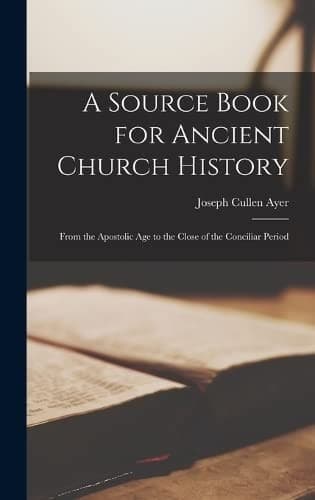
A Source Book for Ancient Church HistoryAyer, Joseph Cullen
History
A Source Book for Ancient Church History
Ayer, Joseph Cullen
Church history -- Primitive and early church, ca. 30-600 -- Sources
Since he was no longer able to prosecute her, he directed his assaults
against a certain Ptolemæus whom Urbicus punished, and who had been the
teacher of the woman in the Christian doctrines. And he did this in the
following way: He persuaded a centurion, his friend, who had cast
Ptolemæus into prison, to take Ptolemæus and interrogate him only as to
whether he were a Christian. And Ptolemæus, being a lover of the truth,
and not of deceitful or false disposition, when he confessed himself to be
a Christian, was thrown in chains by the centurion and for a long time was
punished in prison. At last, when he was brought to Urbicus, he was asked
this one question only: whether he was a Christian. And again, conscious
of the noble things that were his through the teaching of Christ, he
confessed his discipleship in the divine virtue. For he who denies
anything either denies it because he condemns the thing itself or he
avoids confession because he knows his own unworthiness or alienation from
it; neither of which cases is that of a true Christian. And when Urbicus
ordered him to be led away to punishment, a certain Lucius, who was also
himself a Christian, seeing the unreasonable judgment, said to Urbicus:
“What is the ground of this judgment? Why have you punished this man: not
as an adulterer, nor fornicator, nor as one guilty of murder, theft, or
robbery, nor convicted of any crime at all, but who has only confessed
that he is called by the name of Christian? You do not judge, O Urbicus,
as becomes the Emperor Pius, nor the philosopher, the son of Cæsar, nor
the sacred Senate.” And he, replying nothing else to Lucius, said: “You
also seem to me to be such an one.” And when Lucius answered, “Most
certainly I am,” he then ordered him also to be led away. And he professed
his thanks, since he knew that he was going to be delivered from such
wicked rulers and was going to the Father and King of the heavens. And
still a third came forward and was condemned to be punished.
(_b_) _Passion of the Scilitan Martyrs._
Text: J. A. Robinson, _Text and Studies_, I, 2, 112-116,
Cambridge, 1891; reprinted in R. Knopf, _Ausgewählte
Märtyreracten_, 34 _ff._, Tübingen, 1901.
The date of this martyrdom is July 17, 180 A.D. Scili, the place
of residence of these martyrs, was a small city in northwestern
Proconsular Africa. For an account of ancient martyrologies, see
Krüger, §§ 104 _ff._
When Præsens, for the second time, and Claudianus were consuls, on the
seventeenth day of July, and when Speratus, Nartzalus, Cittinus, Donata,
Secunda, and Vestia were brought into the judgment-hall at Carthage, the
proconsul Saturninus said: Ye can win the indulgence of our lord the
Emperor if ye return to a sound mind.
Speratus said: We have never done ill; we have not lent ourselves to
wrong; we have never spoken ill; but when we have received ill we have
given thanks, because we pay heed to our Emperor.
Public-domain text, read in full here on John Shaqi.
Reviews
Reviews
No reviews yet
Be the first to share your thoughts on this work.
Join the Discussion
Join the discussion
Sign in to leave a comment or review.
Sign InorCreate an account