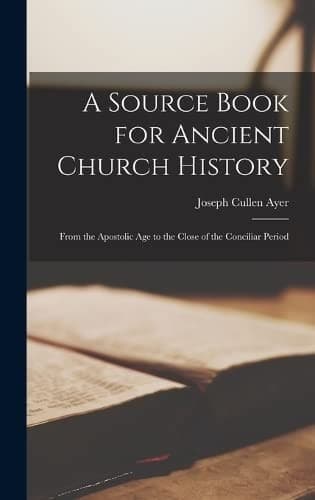
A Source Book for Ancient Church HistoryAyer, Joseph Cullen
History
A Source Book for Ancient Church History
Ayer, Joseph Cullen
Church history -- Primitive and early church, ca. 30-600 -- Sources
Additional source material: The principal authority for the system
of the Valentinians is Irenæus, _Adv. Hær._, Lib. I (ANF), see
also Hippolytus, _Refut._, VI, 24-32 (ANF); “The Hymn of the
Soul,” from the _Acts of Thomas_, trans. by A. A. Bevan, _Texts
and Studies_, III, Cambridge, 1897; _The Fragments of Heracleon_,
trans. by A. E. Burke, _Text and Studies_, I, Cambridge, 1891; see
also ANF, IX, index, p. 526, _s. v., Heracleon_. The _Excerpta
Theodoti_ contained in ANF, VIII, are really the _Excerpta
Prophetica_, another collection, identified with the _Excerpta
Theodoti_ by mistake of the editor of the American edition, A. C.
Coxe (on the _Excerpta_, see Zahn, _History of the Canon of the
New Testament_).
(_a_) Clement of Alexandria, _Strom._, IV, 13. (MSG, 8:1296.)
The following passages appear to be taken from the same homily of
Valentinus. The pneumatics are naturally immortal, but have
assumed mortality to overcome it. Death is the work of the
imperfect Demiurge. The concluding portion, which is very obscure,
does not fit well into the Valentinian system. _Cf._ Hilgenfeld,
_op. cit._, p. 300.
Valentinian in a homily writes in these words: “Ye are originally
immortal, and ye are children of eternal life, and ye desired to have
death distributed to you, that ye may spend and lavish it, and that death
may die in you and by you; for when ye dissolve the world, and are not
yourselves dissolved, ye have dominion over creation and all
corruption.”(44) For he also, similarly with Basilides, supposes a class
saved by nature [_i.e._, the pneumatics, _v. infra_], and that this
different race has come hither to us from above for the abolition of
death, and that the origin of death is the work of the Creator of the
world. Wherefore, also, he thus expounds that Scripture, “No one shall see
the face of God and live” [Ex. 33:20], as if He were the cause of death.
Respecting this God, he makes those allusions, when writing, in these
expressions: “As much as the image is inferior to the living face, so much
is the world inferior to the living Eon. What is, then, the cause of the
image? It is the majesty of the face, which exhibits the figure to the
painter, to be honored by his name; for the form is not found exactly to
the life, but the name supplies what is wanting in that which is formed.
The invisibility of God co-operates also for the sake of the faith of that
which has been fashioned.” For the Demiurge, called God and Father, he
designated the image and prophet of the true God, as the Painter, and
Wisdom, whose image, which is formed, is to the glory of the invisible
One; since the things which proceed from a pair [syzygy] are complements
[_pleromata_], and those which proceed from one are images. But since what
is seen is no part of Him, the soul [_psyche_] comes from what is
intermediate, and is different; and this is the inspiration of the
different spirit.
Public-domain text, read in full here on John Shaqi.
Reviews
Reviews
No reviews yet
Be the first to share your thoughts on this work.
Elsewhere in the archive
Join the Discussion
Join the discussion
Sign in to leave a comment or review.
Sign InorCreate an account