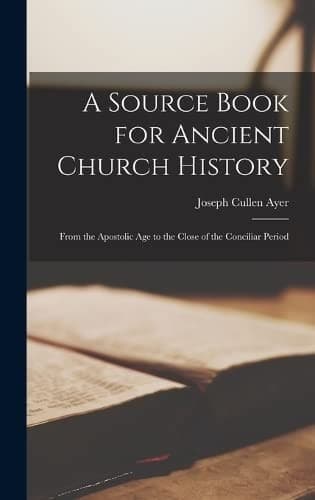
A Source Book for Ancient Church HistoryAyer, Joseph Cullen
History
A Source Book for Ancient Church History
Ayer, Joseph Cullen
Church history -- Primitive and early church, ca. 30-600 -- Sources
And generally what is breathed into the soul, which is
the image of the spirit [_pneuma_], and in general, what is said of the
Demiurge, who was made according to the image, they say was foretold by a
sensible image in the book of Genesis respecting the origin of man; and
the likeness they transfer to themselves, teaching that the addition of
the different spirit was made, unknown to the Demiurge.
(_b_) Clement of Alexandria, _Strom._, II, 20. (MSG, 8:1057.)
According to Basilides, the various passions of the soul were no
original parts of the soul, but appendages to the soul. “They were
in essence certain spirits attached to the rational soul, through
some original perturbation and confusion; and that again, other
bastard and heterogeneous natures of spirits grow onto them, like
that of the wolf, the ape, the lion, and the goat, whose
properties, showing themselves around the soul, they say,
assimilate the lusts of the soul to the likeness of these
animals.” See the whole passage immediately preceding the
following fragment. The fragment can best be understood by
reference to the presentation of the system by W. Bousset in
_Encyc. Brit._, eleventh ed., art. “Basilides.”
Valentinus, too, in a letter to certain people, writes in these very words
respecting the appendages: “There is One good, by whose presence is the
manifestation, which is by the Son, and by Him alone can the heart become
pure, by the expulsion of every evil spirit from the heart; for the
multitude of spirits dwelling in it do not suffer it to be pure; but each
of them performs his own deeds, insulting it oft with unseemly lusts. And
the heart seems to be treated somewhat like a caravansary. For the latter
has holes and ruts made in it, and is often filled with filthy dung; men
living filthily in it, and taking no care for the place as belonging to
others. So fares it with the heart as long as there is no thought taken
for it, being unclean and the abode of demons many. But when the only good
Father visits it, it is sanctified and gleams with light. And he who
possesses such a heart is so blessed that he shall see God.”
(_c_) Clement of Alexandria, _Strom._, II. 8. (MSG, 8:972.)
The teaching in the following passage attaches itself to the text,
“The fear of God is the beginning of wisdom” (_cf._ Prov. 1:7).
Compare with it Irenæus, _Adv. Hær._, I, 30:6.
Here the followers of Basilides, interpreting this expression [Prov. 1:7]
say that “the Archon, having heard the speech of the Spirit, who was being
ministered to, was struck with amazement both with the voice and the
vision, having had glad tidings beyond his hopes announced to him; and
that his amazement was called fear, which became the origin of wisdom,
which distinguishes classes, and discriminates, and perfects, and
restores. For not the world alone, but also the election, He that is over
all has set apart and sent forth.”
Public-domain text, read in full here on John Shaqi.
Reviews
Reviews
No reviews yet
Be the first to share your thoughts on this work.
Elsewhere in the archive
Join the Discussion
Join the discussion
Sign in to leave a comment or review.
Sign InorCreate an account