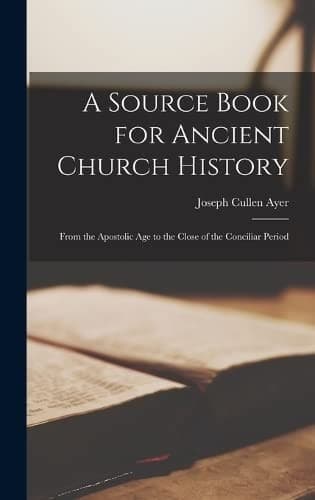
A Source Book for Ancient Church HistoryAyer, Joseph Cullen
History
A Source Book for Ancient Church History
Ayer, Joseph Cullen
Church history -- Primitive and early church, ca. 30-600 -- Sources
First of all, it is to be known that the entire Law contained in the
Pentateuch of Moses was not given by one—I mean not by God alone; but some
of its precepts were given by men, and the words of the Saviour teach us
to divide it into three parts. For He attributes some of it to God himself
and His law-giving, and some to Moses, not in the sense that God gave laws
through him, but in the sense that Moses, impelled by his own spirit, set
down some things as laws; and He attributes some things to the elders of
the people, who first discovered certain commandments of their own and
then inserted them. How this was so you clearly learn from the words of
the Saviour. Somewhere the Saviour was conversing with the people, who
disputed with Him about divorce, that it was allowed in the Law, and He
said to them: Moses, on account of the hardness of your hearts, permitted
a man to divorce his wife; but from the beginning it was not so. For God,
said He, joined this bond, and what the Lord joined together let not man,
He said, put asunder. He therefore pointed out one law that forbids a
woman to be separated from her husband, which was of God, and another,
which was of Moses, that allows, on account of the hardness of men’s
hearts, the bond to be dissolved. And accordingly, Moses gives a law
opposed to God, for it is opposed to the law forbidding divorce. But if we
consider carefully the mind of Moses, according to which he thus
legislated, we shall find that he did not do this of his own mere choice,
but by constraint because of the weakness of those to whom he was giving
the law. For since they were not able to observe that precept of God by
which it was not permitted them to cast forth their wives, with whom some
of them lived unhappily, and because of this they were in danger of
falling still more into unrighteousness, and from that into utter ruin,
Moses, intending to avoid this unhappy result, because they were in danger
of ruin, gave a certain second law, according to circumstances less evil,
in place of the better; and by his own authority gave the law of divorce
to them, that if they could not keep that they might keep this, and should
not fall into unrighteousness and wickedness by which complete ruin should
overtake them. This was his purpose in as far as he is found giving laws
contrary to God. That thus the law of Moses is shown to be other than the
Law of God is indisputable, if we have shown it in one instance.
Public-domain text, read in full here on John Shaqi.
Reviews
Reviews
No reviews yet
Be the first to share your thoughts on this work.
Elsewhere in the archive
Join the Discussion
Join the discussion
Sign in to leave a comment or review.
Sign InorCreate an account