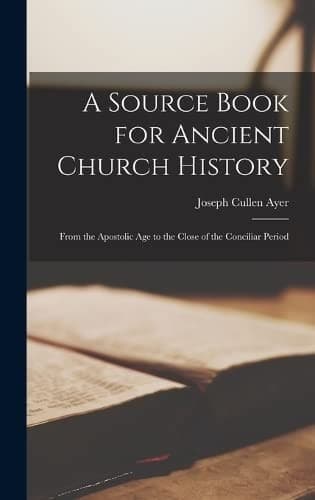
A Source Book for Ancient Church HistoryAyer, Joseph Cullen
History
A Source Book for Ancient Church History
Ayer, Joseph Cullen
Church history -- Primitive and early church, ca. 30-600 -- Sources
And as to there being certain traditions of the elders which have been
incorporated in the Law, the Saviour shows this also. For God, said He,
commanded: Honor thy father and thy mother, that it may be well with thee.
But ye, He said, addressing the elders, have said: It is a gift to God,
that by which ye might be profited by me, and ye annul the law of God by
the traditions of your elders. And this very thing Isaiah declared when he
said: This people honor me with their lips, but their heart is far from
me, vainly do they worship me, teaching the doctrines and commandment of
men [_cf._ Matt. 15:4-9.] Clearly, then, from these things it is shown
that this whole Law is to be divided into three parts. And in it we find
laws given by Moses, by the elders, and by God; and this division of the
whole Law as we have made it, has shown the real truth as to the Law.
But one portion of the Law, that which is from God, is again to be divided
into three parts: first, into the genuine precepts, quite untainted with
evil, which is properly called the law, and which the Saviour came not to
destroy but to complete (for what he completed was not alien to Him, but
yet it was not perfect); secondly, the part comprising evil and
unrighteous things, which the Saviour did away with as something unfitting
His nature; and thirdly, the part which is for types and symbols, which is
given as a law, as images of things spiritual and excellent which, from
being evident and manifest to the senses, the Saviour changed into the
spiritual and unseen. Now the law of God, pure and untainted with anything
base, is the Decalogue itself, or those ten precepts distributed in two
tables, for the prohibition of things to be avoided and the performance of
things to be done. Although they constitute a pure body of laws, yet they
are not perfect, but need to be completed by the Saviour. But there is
that body of commands which are tainted with unrighteousness; such is the
law requiring vengeance and requital of injuries upon those who have first
injured us, commanding the smiting out of an eye for an eye and a tooth
for a tooth and revenging bloodshed with bloodshed. For one who is second
in doing unrighteousness acts no less unrighteously, when the difference
is only one of order, doing the self-same work. But such a precept was,
and is, in other respects just, because of the infirmity of those to whom
the law was given, and it was given in violation of the pure law, and was
not consonant with the nature and goodness of the Father of all; it was to
a degree appropriate, but yet given under a certain compulsion. For he who
forbids the commission of a single murder in that he says, Thou shalt not
kill, but commands that he who kills shall in requital be killed, gives a
second law and commands a second slaying, when he has forbidden one, and
has been compelled to do this by necessity. And therefore the Son, sent by
Him, abolishes this portion of the Law, He himself confessing that it is
Public-domain text, read in full here on John Shaqi.
Reviews
Reviews
No reviews yet
Be the first to share your thoughts on this work.
Elsewhere in the archive
Join the Discussion
Join the discussion
Sign in to leave a comment or review.
Sign InorCreate an account