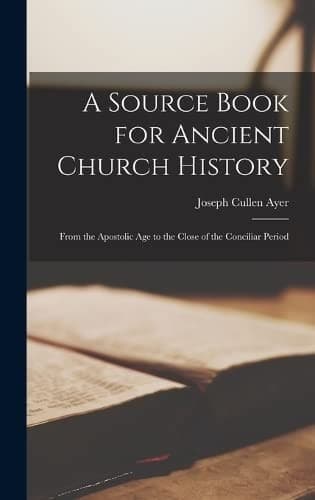
A Source Book for Ancient Church HistoryAyer, Joseph Cullen
History
A Source Book for Ancient Church History
Ayer, Joseph Cullen
Church history -- Primitive and early church, ca. 30-600 -- Sources
Come, now, you who would indulge a better curiosity, if you would apply it
to the business of your salvation, run over the apostolic churches, in
which the very thrones of the Apostles are still pre-eminent in their
places, in which their own authentic writings are read, uttering the voice
and representing the face of each of them severally. Achaia is very near
you, in which you find Corinth. Since you are not far from Macedonia, you
have Philippi; there, too, you have the Thessalonians. Since you are able
to cross to Asia, you get Ephesus. Since, moreover, you are close upon
Italy, you have Rome, from which there comes even into our own hands the
very authority of Apostles themselves. How happy is that church, on which
Apostles poured forth all their doctrine along with their blood! Where
Peter endures a passion like his Lord’s; where Paul wins a crown in a
death like John’s; where the Apostle John was first plunged, unhurt, into
boiling oil, and thence remitted to his island exile! See what she has
learned, what taught; what fellowship she has had with even our churches
in Africa! One Lord God does she acknowledge, the Creator of the universe,
and Christ Jesus born of the Virgin Mary, the Son of God the Creator; and
the resurrection of the flesh; the law and the prophets she unites in one
volume with the writings of Evangelists and Apostles, from which she
drinks in her faith. This she seals with the water of baptism, arrays with
the Holy Ghost, feeds with the eucharist, cheers with martyrdom, and
against such a discipline thus maintained she admits no gainsayer.
§ 28. The Canon or the Authoritative New Testament Writings
The Gnostics used in support of their doctrines writings which they
attributed to the Apostles, thus having a direct apostolic witness to
these doctrines. This they did in imitation of the Church’s practice of
using apostolic writings for edification and instruction. Marcion drew up
a list of books which were alone to be regarded as authoritative among his
followers [_v. supra_, § 23, _a_]. The point to be made by the champions
of the faith of the great body of Christians was that only those books
could be legitimately used in support of Christian doctrine which could
claim actual apostolic origin and had been used continuously in the
Church. As a fact, the books to which they appealed had been in use
generation after generation, but the Gnostic works were unknown until a
comparatively recent time and were too closely connected with only the
founders of a sect to deserve credence. It was a simple literary argument
and appeal to tangible evidence. The list of books regarded as
authoritative constituted the Canon of Scripture. The state of the Canon
in the second half of the second century, especially in the West, is shown
in the following extracts.
Additional source material: See Preuschen, _Analecta_, II,
Tübingen, 1910; Tatian, Diatessaron, ANF, IX; The Gospel of Peter,
_ibid._
Public-domain text, read in full here on John Shaqi.
Reviews
Reviews
No reviews yet
Be the first to share your thoughts on this work.
Elsewhere in the archive
Join the Discussion
Join the discussion
Sign in to leave a comment or review.
Sign InorCreate an account