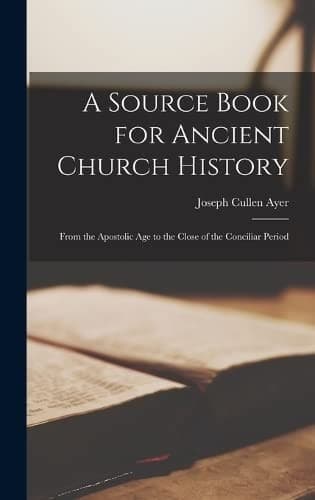
A Source Book for Ancient Church HistoryAyer, Joseph Cullen
History
A Source Book for Ancient Church History
Ayer, Joseph Cullen
Church history -- Primitive and early church, ca. 30-600 -- Sources
It is not possible that the gospels be either more or fewer than they are.
For since there are four regions of the world in which we live, and four
principal winds, and the Church is scattered over the whole earth, and the
pillar and ground of the Church is the Gospel and the Spirit of Life, it
is fitting that she should have four pillars, breathing forth immortality
on every side, and giving life to men. From this it is evident that the
Word, the Artificer of all, who sitteth upon the cherubim and who contains
all things and was manifested to men, has given us the Gospel under four
forms, but bound together by one Spirit. As also David says when he prayed
for His coming: “Thou that sittest between the cherubim, shine forth”
[_cf._ Psalm 80:1]. For the cherubim, also, were four-faced, and their
faces were images of the dispensation of the Son of God. For he says, “The
first living creature was like a lion” [_cf._ Ezek. 1:5 _ff._],
symbolizing His effectual working, leadership, and royal power; the second
was like a calf, symbolizing His sacrificial and sacerdotal order; but
“the third had, as it were, the face of a man,” evidently describing His
coming as a human being; “the fourth was like a flying eagle,” pointing
out the gift of the Spirit hovering over the Church. And therefore the
gospels are in accord with these things, among which Christ is seated. For
that according to John relates His original, effectual, and glorious
generation from the Father, thus declaring, “In the beginning was the Word
and the Word was with God and the Word was God” [_cf._ John 1:1 _ff._],
and further, “All things were made by Him and without Him was nothing
made.” For this reason, also, is that Gospel full of confidence, for such
is His person. But that according to Luke, which takes up His priestly
character, commenced with Zacharias, the priest, who offers sacrifice to
God. For now was made ready the fatted calf, about to be immolated for the
recovery of the younger son [Luke 15:23]. Matthew, again, relates His
generation as a man, saying, “The book of the generation of Jesus Christ,
the son of David, the son of Abraham” [Matt. 1:1]; and “The birth of Jesus
Christ was on this wise” [Matt. 1:18]. This, then, is the gospel of His
humanity; for which reason the character of a humble and meek man is kept
up through the whole gospel. Mark, on the other hand, commences with
reference to the prophetical Spirit who comes down from on high to men,
saying, “The beginning of the Gospel of Jesus Christ, as it is written in
Isaiah the prophet,” pointing to the winged aspect of the Gospel, and on
this account he makes a compendious and brief narrative, for such is the
prophetical character. And the Word of God himself had intercourse with
the patriarchs, before Moses, in accordance with His divinity and glory;
but for those under the Law He instituted a sacerdotal and liturgical
service. Afterward, having been made man for us, He sent the gift of the
Public-domain text, read in full here on John Shaqi.
Reviews
Reviews
No reviews yet
Be the first to share your thoughts on this work.
Elsewhere in the archive
Join the Discussion
Join the discussion
Sign in to leave a comment or review.
Sign InorCreate an account