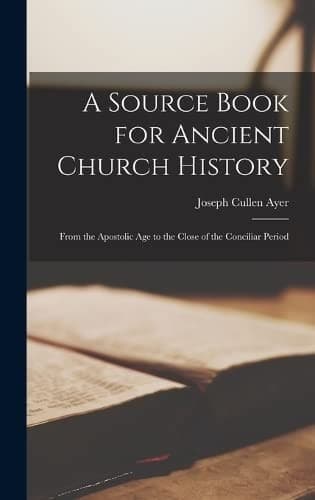
A Source Book for Ancient Church HistoryAyer, Joseph Cullen
History
A Source Book for Ancient Church History
Ayer, Joseph Cullen
Church history -- Primitive and early church, ca. 30-600 -- Sources
The epistles, however, of Paul make themselves plain to those who wish to
understand what epistles were sent by him, and from what place and for
what cause. He wrote at some length, first of all, to the Corinthians,
forbidding schisms and heresies; next to the Galatians, forbidding
circumcision; then to the Romans, impressing on them the plan of the
Scriptures, and also that Christ is the first principle of them,
concerning which severally it is necessary for us to discuss, since the
blessed Apostle Paul himself, following the order of his predecessor John,
writes only by name to seven churches in the following order: to the
Corinthians a first, to the Ephesians a second, to the Philippians a
third, to the Colossians a fourth, to the Galatians a fifth, to the
Thessalonians a sixth, to the Romans a seventh; and yet, although for the
sake of admonition there is a second to the Corinthians and to the
Thessalonians, but one Church is recognized as being spread over the
entire world. For John, too, in the Apocalypse, though he writes to seven
churches, yet speaks to all. Howbeit to Philemon one, to Titus one, and to
Timothy two were put in writing from personal inclination and attachment,
to be in honor, however, with the Catholic Church for the ordering of the
ecclesiastical mode of life. There is current, also, one to the
Laodiceans, another to the Alexandrians, [both] forged in Paul’s name to
suit a heresy of Marcion, and several others, which cannot be received
into the Catholic Church; for it is not fitting that gall be mixed with
honey.
The Epistle of Jude, no doubt, and the couple bearing the name of John are
accepted in the Catholic [Church], and the Wisdom written by the friends
of Solomon in his honor. The Apocalypse, also, of John and of Peter only
we receive; which some of us will not have read in the Church. But the
Shepherd was written quite lately in our times by Hermas, while his
brother Pius, the bishop, was sitting in the chair of the church of the
city of Rome; and therefore it ought to be read, indeed, but it cannot to
the end of time be publicly read in the Church to the people, either among
the prophets, who are complete in number, or among the Apostles.
But of Valentinus, the Arsinoite, and his friends, we receive nothing at
all, who have also composed a long new book of Psalms, together with
Basilides and the Asiatic founder of the Montanists.
(_b_) Irenæus, _Adv. Hær._, III, II:8. (MSG, 7:885.)
The following extract illustrates the allegorical method of
exegesis in use throughout the Church, and also the opinion of the
author that there were but four gospels, and could be no more than
four. It should be noted that the symbolism of the beasts is not
that which has become current in ecclesiastical art.
Public-domain text, read in full here on John Shaqi.
Reviews
Reviews
No reviews yet
Be the first to share your thoughts on this work.
Elsewhere in the archive
Join the Discussion
Join the discussion
Sign in to leave a comment or review.
Sign InorCreate an account