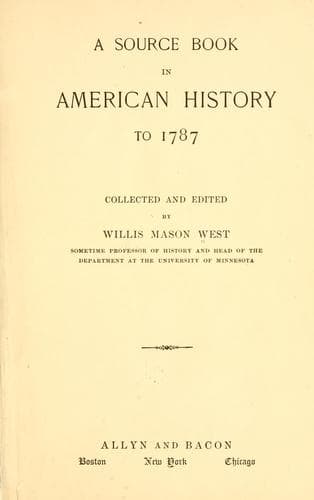
The following passages come from the introduction to Smith's
"Pathway to the Inexperienced," his last pamphlet, written in 1631,
to support the Massachusetts Bay Colony. Smith wrote at the home
of a brother of John Winthrop's first wife, and seems to have been
well acquainted with the Puritan leaders.
Pardon me if I offend in loving that [which] I have cherished truly,
by the losse of my prime fortunes, meanes, and youth. If it over-glad
me to see Industry her selfe adventure now to make use of my aged
ende[a]vours, _not by such (I hope) as rumour doth report, a many of
discontented Brounists, Anabaptists, Papists, Puritans, Separatists,
and such factious Humorists: for no such they will suffer among them,
if knowne, as many of the chiefe of then (John Winthrop etc.) have
assured mee; and the much conferences I have had with many of them,
doth confidently perswade me to write thus much in their behalfe. ..._
They have ... God's true Religion (they say) taught amongst themselves,
the Sabbath day observed, the common Prayer (as I understand) and
Sermons performed, and diligent catechising ... and commendable good
orders to bring those people [natives] with whom they have to deale ...
into a Christian conversation ... which done, in time, ... may grow =_a
good addition to the Church of England_=.
[Smith evidently had some doubts on the matter, as his
parenthetical expressions show. But he had confidence enough to
_dedicate this booklet to the two Archbishops of Canterbury and
York_.]
61. Political Principles of the Puritans
From John Calvin's _Institutes_ (1559; translation of 1813, III,
517-551).
_a. [Attempt to justify a union of church and state]_
III.--Nor let anyone think it strange that I refer to human polity
the due maintenance of religion ... I do not allow men to make laws
respecting religion and the worship of God ... though I approve of
civil government which provides that the true religion, ... contained
in the law of God, be not violated and poluted.
_b. [Of the parts of government and the supremacy of magistrates]_
These are three. The Magistrate, who is the guardian and
conservator of the laws: The Laws, according to which he
governs: The People, who are governed by the laws, and obey the
magistrate....
IV.--The Lord hath not only testified that the function of magistrates
has his approbation and acceptance, but hath eminently commended it to
us, by dignifying it with the most honourable titles. ... This is just
as if it had been affirmed, that the authority possessed by kings and
other governors over all things upon earth is not a consequence of the
perverseness of men, but of the providence and holy ordinance of God....
Public-domain text, read in full here on John Shaqi.
Reviews
Reviews
No reviews yet
Be the first to share your thoughts on this work.
Elsewhere in the archive
Join the Discussion
Join the discussion
Sign in to leave a comment or review.
Sign InorCreate an account