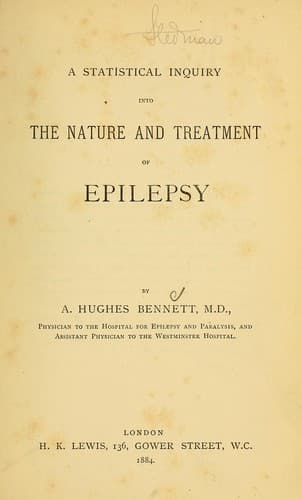
A Statistical Inquiry Into the Nature and Treatment of Epilepsy — John Shaqi
A Statistical Inquiry Into the Nature and Treatment of EpilepsyBennett, Alexander Hughes
Science
A Statistical Inquiry Into the Nature and Treatment of Epilepsy
Bennett, Alexander Hughes
Epilepsy
Here it may be observed that of 7 cases complicated with hemiplegia, in
1 the attacks were increased after treatment, but all the others were
relieved in average proportion. Of the 5 cases in idiots, in 1 there was
no improvement, in 1 the attacks were subsequently augmented, and in the
others there was improvement. The numbers are far too limited to found
any reliable dictum upon; at the same time, it must be admitted that
while epilepsy complicated with these grave lesions is perfectly
amenable to treatment, this table serves to show that the proportion of
non-success is comparatively large.
It has been stated before that no attempt would be made in this paper to
prove that epilepsy was curable by therapeutic means. Its aim has been
to show the effects of the bromides on the attacks or symptoms of that
disease. It is common to hear it remarked, as if this were of no
importance, "You only arrest the fits, but you do not know, and cannot
cure, the original lesion. You do not go to the fountain-head of the
disease, but simply relieve its results." In reply, I would ask, Of what
disease do we know the ultimate nature any better than that of epilepsy?
and if we did, how would that assist us in treating it? What drug in our
pharmacopoeia cures any single disease, or do other than, by attacking
and relieving symptoms, leave nature to remove the morbid lesion? Even
quinine, to which therapeutists triumphantly point, only arrests certain
paroxysms until time removes the poison from the blood, as it does in
most malarious affections. So far from being a small matter, I believe
there are few, if any, drugs at our disposal which can be demonstrated
to have a more beneficial action in the treatment of disease than that
of the bromides, in epilepsy. Besides, I decline to admit the statement
that complete recovery does not follow their administration. Various
authors have reported cases, and that these are rare is due to reasons
stated before, and chiefly on account of the long period of treatment
necessary to ensure success.
This inquiry may be summed up in the following general conclusions:--
1. In 12.1 per cent. of epileptics the attacks were completely arrested
during the whole period of treatment by the bromides.
2. In 83.3 per cent. the attacks were greatly diminished both in number
and severity.
3. In 2.3 per cent. the treatment had no apparent effect.
4. In 2.3 per cent. the number of attacks was augmented during the
period of treatment.
5. The form of the disease, whether it was inherited or not, whether
complicated or not, recent or chronic, in the young or in the old, in
healthy or diseased persons, appeared in no way to influence treatment,
the success being nearly in the _same ratio_ under all these
conditions.
FOOTNOTES:
[B] Reprinted from the "Edinburgh Medical Journal" for February and
March, 1881.
[C] For an extended experience, see the next paper.
III.
AN INQUIRY
INTO THE
EFFECTS OF THE PROLONGED
Public-domain text, read in full here on John Shaqi.
Reviews
Reviews
No reviews yet
Be the first to share your thoughts on this work.
Join the Discussion
Join the discussion
Sign in to leave a comment or review.
Sign InorCreate an account