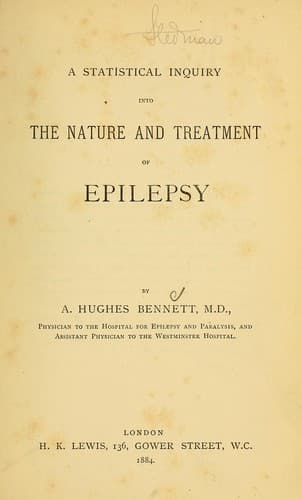
A Statistical Inquiry Into the Nature and Treatment of Epilepsy — John Shaqi
A Statistical Inquiry Into the Nature and Treatment of EpilepsyBennett, Alexander Hughes
Science
A Statistical Inquiry Into the Nature and Treatment of Epilepsy
Bennett, Alexander Hughes
Epilepsy
To ascertain the exciting causes of epileptic seizures with exactitude
is usually a matter of very great difficulty. It is simple enough when
the results directly follow the cause; but this is not commonly the
case. If, for example, a man, after a blow on the head (having been
previously in good health) becomes suddenly seized with epileptic
attacks within a few hours or days of the accident, we may fairly assume
that the injury has originated or developed his illness. But should the
seizure not supervene for some months or years afterwards, the external
wound having in the meantime completely recovered, there remains on this
question a considerable element of doubt. In the same way a patient
often attributes the attacks to a fright which may have occurred weeks
or months before they began; yet great care should be taken in accepting
such a statement: on the other hand, it should not be utterly ignored.
Again, if a person develops epilepsy after severe and prolonged domestic
trouble or affliction, how are we accurately to determine the relation
between the two? These difficulties render an exact method of
ascertaining the exciting causes almost impossible, and this can only be
approximated by a careful consideration of the entire history and
circumstances of the case. Taking these into consideration, the
following statements have been drawn up, in which only those conditions
are recorded, where from a review of the whole case a reasonable
relation was found to exist between cause and effect.
In a hundred unselected cases of epilepsy there were--
No apparent exciting cause in 43 per cent.
Possible exciting cause in 57 per cent.
Of the cases where a possible exciting cause was present, the following
is an analysis:--
Blow or injury to head in 28.1 per cent.
Uterine disorder in 22.8 per cent.
Domestic trouble in 15.7 per cent.
Disease of the nervous system in 8.7 per cent.
Fright in 5.2 per cent.
Depression in 5.2 per cent.
Pregnancy in 5.2 per cent.
Mental strain in 3.5 per cent.
Sunstroke in 3.5 per cent.
Emotion in 1.7 per cent.
Thus, in no fewer than 16 per cent. of the total number of cases, and
28.1 of those in which a possible exciting cause was present, did
epileptic seizures follow injuries to the head. Of the cases recorded
under uterine disorders, it must be stated that these conditions were as
much the accompaniments as the cause of epilepsy, the relations between
the two being as follows:--
Attacks occurring at menstrual periods in 61.5 per cent.
Attacks associated with irregular menstruation in 30.7 per cent.
Attacks associated with uterine disease in 7.6 per cent.
Public-domain text, read in full here on John Shaqi.
Reviews
Reviews
No reviews yet
Be the first to share your thoughts on this work.
Join the Discussion
Join the discussion
Sign in to leave a comment or review.
Sign InorCreate an account