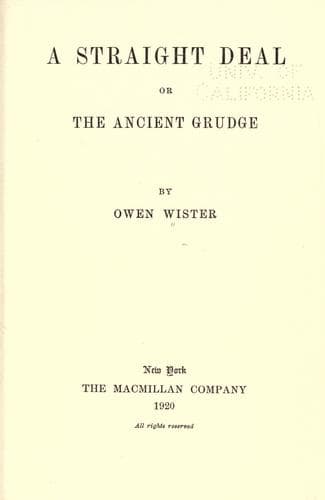
A Straight Deal; Or, The Ancient Grudge — John Shaqi
A Straight Deal; Or, The Ancient GrudgeWister, Owen
History
A Straight Deal; Or, The Ancient Grudge
Wister, Owen
Great Britain -- Relations -- United States; United States -- Relations -- Great Britain
Germans remain German. An American lady of my acquaintance was about
to climb from Amalfi to Ravello in company with a German lady of her
acquaintance. The German lady had a German Baedeker, the American a
Baedeker in English, published several years apart. The Baedeker in
German recommended a path that went straight up the ascent, the Baedeker
in English a path that went up more gradually around it. “Mine says
this is the best way,” said the American. “Mine says straight up is
the best,” said the German. “But mine is a later edition,” said the
American. “That is not it,” explained the German. “It is that we Germans
are so much more clever and agile, that to us is recommended the more
dangerous way while Americans are shown the safe path.”
That happened in 1910. That is Kultur. This too is Kultur:
“If Silesia become Polish
Then, oh God, may children perish, like beasts, in their mothers’ womb.
Then lame their Polish feet and their hands, oh God!
Let them be crippled and blind their eyes.
Smite them with dumbness and madness,both men and women.”
From a Hymn of German hate for the Poles.
Germany remains German; but when next she springs, she will make no
blunders.
Chapter V: The Ancient Grudge
It was in Broad Street, Philadelphia, before we went to war, that I
overheard the foolish--or propagandist--slur upon England in front of
the bulletin board. After we were fighting by England’s side for our
existence, you might have supposed such talk would cease. It did not.
And after the Armistice, it continued. On the day we celebrated as
“British Day,” a man went through the crowd in Wanamaker’s shop,
asking, What had England done in the War, anyhow? Was he a German, or
an Irishman, or an American in pay of Berlin? I do not know. But this I
know: perfectly good Americans still talk like that. Cowboys in camp do
it. Men and women in Eastern cities, persons with at least the external
trappings of educated intelligence, play into the hands of the Germany
of to-morrow, do their unconscious little bit of harm to the future of
freedom and civilization, by repeating that England “has always been our
enemy.” Then they mention the Revolution, the War of 1812, and England’s
attitude during our Civil War, just as they invariably mentioned these
things in 1917 and 1918, when England was our ally in a struggle (or
life, and as they will be mentioning them in 1940, I presume, if they
are still alive at that time).
Public-domain text, read in full here on John Shaqi.
Reviews
Reviews
No reviews yet
Be the first to share your thoughts on this work.
Join the Discussion
Join the discussion
Sign in to leave a comment or review.
Sign InorCreate an account