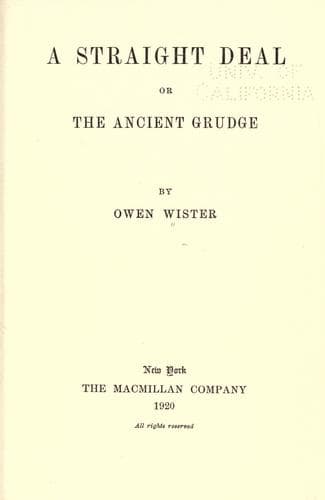
A Straight Deal; Or, The Ancient GrudgeWister, Owen
History
A Straight Deal; Or, The Ancient Grudge
Wister, Owen
Great Britain -- Relations -- United States; United States -- Relations -- Great Britain
This land was the Indian’s house, not ours. He was here first, nobody
knows how many centuries first. We arrived, and we shoved him, and
shoved him, and shoved him, back, and back, and back. Treaty after
treaty we made with him, and broke. We drew circles round his freedom,
smaller and smaller. We allowed him such and such territory, then took
it away and gave him less and worse in exchange. Throughout a century
our promises to him were a whole basket of scraps of paper. The other
day I saw some Indians in California. It had once been their place. All
over that region they had hunted and fished and lived according to their
desires, enjoying life, liberty, and the pursuit of happiness. We came.
To-day the hunting and fishing are restricted by our laws--not the
Indian’s--because we wasted and almost exterminated in a very short
while what had amply provided the Indian with sport and food for a very
long while.
In that region we have taken, as usual, the fertile land and the running
water, and have allotted land to the Indian where neither wood nor water
exist, no crops will grow, no human life can be supported. I have seen
the land. I have seen the Indian begging at the back door. Oh, yes, they
were an “inferior race.” Oh, yes, they didn’t and couldn’t use the land
to the best advantage, couldn’t build Broadway and the Union Pacific
Railroad, couldn’t improve real estate. If you choose to call the whole
thing “manifest destiny,” I am with you. I’ll not dispute that what
we have made this continent is of greater service to mankind than the
wilderness of the Indian ever could possibly have been--once conceding,
as you have to concede, the inevitableness of civilization. Neither you,
nor I, nor any man, can remold the sorry scheme of things entire. But we
could have behaved better to the Indian. That was in our power. And we
gave him a raw deal instead, not once, but again and again. We did it
because we could do it without risk, because he was weaker and we could
always beat him in the end. And all the while we were doing it, there
was our Bill of Rights, our Declaration of Independence, founded on
a new thing in the world, proclaiming to mankind the fairest hope
yet born, that “All men are endowed by their Creator with certain
inalienable rights,” and that these were now to be protected by law. Ah,
no, look at it as you will, it is a black page, a raw deal. The officers
of our frontier army know all about it, because they saw it happen. They
saw the treaties broken, the thieving agents, the trespassing settlers,
the outrages that goaded the deceived Indian to despair and violence,
and when they were ordered out to kill him, they knew that he had struck
in self-defense and was the real victim.
Public-domain text, read in full here on John Shaqi.
Reviews
Reviews
No reviews yet
Be the first to share your thoughts on this work.
Join the Discussion
Join the discussion
Sign in to leave a comment or review.
Sign InorCreate an account