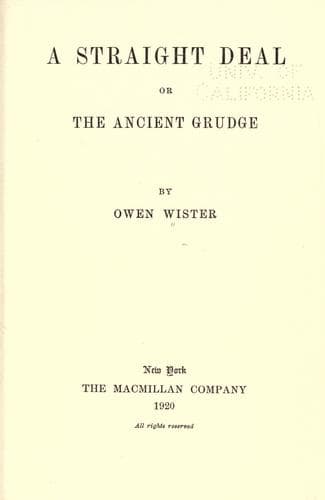
A Straight Deal; Or, The Ancient GrudgeWister, Owen
History
A Straight Deal; Or, The Ancient Grudge
Wister, Owen
Great Britain -- Relations -- United States; United States -- Relations -- Great Britain
Englishmen were on our side that they would not enlist against us,
refused to fight us, and George III had to go to Germany and obtain
Hessians to help him out. His war against us was lost at home, on
English soil, through English disapproval of his course, almost as much
as it was lost here through the indomitable Washington and the help of
France. That is the actual state of the case, there is the truth. Did
you hear much about this at school? Did you ever learn there that George
III had a fake Parliament, largely elected by fake votes, which did not
represent the English people; that this fake Parliament was autocracy’s
last ditch in England; that it choked for a time the English democracy
which, after the setback given it by the excesses of the French
Revolution, went forward again until to-day the King of England has less
power than the President of the United States? I suppose everybody in
the world who knows the important steps of history knows this--except
the average American. From him it has been concealed by his school
histories; and generally he never learns anything about it at all,
because once out of school, he seldom studies any history again. But
why, you may possibly wonder, have our school histories done this? I
think their various authors may consciously or unconsciously have felt
that our case against England was not in truth very strong, that in fact
she had been very easy with us, far easier than any other country was
being with its colonies at that time. The King of France taxed his
colonies, the King of Spain filled his purse, unhampered, from the
pockets of Mexico and Peru and Cuba and Porto Rico--from whatever pocket
into which he could put his hand, and the Dutch were doing the same
without the slightest question of their right to do it. Our quarrel
with the mother country and our breaking away from her in spite of the
extremely light rein she was driving us with, rested in reality upon
very slender justification. If ever our authors read of the meeting
between Franklin, Rutledge, and Adams with General Howe, after the
Battle of Long Island, I think they may have felt that we had almost no
grievance at all. The plain truth of it was, we had been allowed for
so long to be so nearly free that we determined to be free entirely,
no matter what England conceded. Therefore these authors of our school
textbooks felt that they needed to bolster our cause up for the benefit
of the young. Accordingly our boys’ and girls’ sense of independence
and patriotism must be nourished by making England out a far greater
oppressor than ever she really had been. These historians dwelt as
heavily as they could upon George III and his un-English autocracy, and
as lightly as they could upon the English Pitt and upon all the English
sympathy we had. Indeed, about this most of them didn’t say a word.
Public-domain text, read in full here on John Shaqi.
Reviews
Reviews
No reviews yet
Be the first to share your thoughts on this work.
Join the Discussion
Join the discussion
Sign in to leave a comment or review.
Sign InorCreate an account