A Straight Deal; Or, The Ancient Grudge — John Shaqi
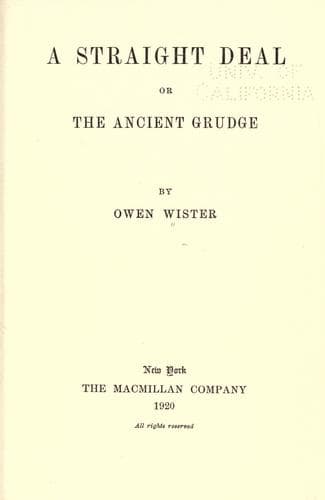
A Straight Deal; Or, The Ancient GrudgeWister, Owen
History
A Straight Deal; Or, The Ancient Grudge
Wister, Owen
Great Britain -- Relations -- United States; United States -- Relations -- Great Britain
The word complex has been in our dictionary for a long while. This
familiar adjective has been made by certain scientific people into a
noun, and for brevity and convenience employed to denote something that
almost all of us harbor in some form or other. These complexes, these
lumps of ideas or impressions that match each other, that are of the
same pattern, and that are also invariably tinctured with either a
pleasurable or painful emotion, lie buried in our minds, unthought-of
but alive, and lurk always ready to set up a ferment, whenever some new
thing from outside that matches them enters the mind and hence starts
them off. The “suppressed complex” I need not describe, as our English
complex is by no means suppressed. Known to us all, probably, is the
political complex. Year after year we have been excited about elections
and candidates and policies, preferring one party to the other. If
this preference has been very marked, or even violent, you know how
disinclined we are to give credit to the other party for any act or
policy, no matter how excellent in itself, which, had our own party been
its sponsor, we should have been heart and soul for. You know how
easily we forget the good deeds of the opposite party and how easily
we remember its bad deeds. That’s a good simple ordinary example of a
complex. Its workings can be discerned in the experience of us all. In
our present discussion it is very much to the point.
Established in the soft young minds of our school boys and girls by
a series of reiterated statements about the tyranny and hostility of
England towards us in the Revolution, statements which they have to
remember and master by study from day to day, tinctured by the anxiety
about the examination ahead, when the students must know them or fail,
these incidents of school work being also tinctured by another emotion,
that of patriotism, enthusiasm for Washington, for the Declaration of
Independence, for Valley Forge--thus established in the regular way of
all complexes, this anti-English complex is fed and watered by what we
learn of the War of 1812, by what we learn of the Civil War of 1861, and
by many lesser events in our history thus far. And just as a Republican
will admit nothing good of a Democrat and a Democrat nothing good of
a Republican because of the political complex, so does the great--the
vast--majority of Americans automatically and easily remember everything
against England and forget everything in her favor. Just try it any day
you like. Ask any average American you are sitting next to in a train
what he knows about England; and if he does remember anything and can
tell it to you, it will be unfavorable nine times in ten. The mere word
“England” starts his complex off, and out comes every fact it has seized
that matches his school-implanted prejudice, just as it has rejected
every fact that does not match it. There is absolutely no other way
to explain the American habit of speaking ill of England and well of
Public-domain text, read in full here on John Shaqi.
Reviews
Reviews
No reviews yet
Be the first to share your thoughts on this work.
Join the Discussion
Join the discussion
Sign in to leave a comment or review.
Sign InorCreate an account