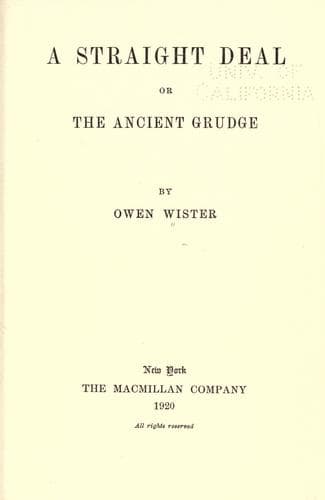
A Straight Deal; Or, The Ancient GrudgeWister, Owen
History
A Straight Deal; Or, The Ancient Grudge
Wister, Owen
Great Britain -- Relations -- United States; United States -- Relations -- Great Britain
dukes, torpedoed stewardesses, and everything between.
Seven hundred thousand of these were engaged on munition work proper.
They did from 60 to 70 per cent of all the machine work on shells,
fuses, and trench warfare supplies, and 1450 of them were trained
mechanics to the Royal Flying Corps. They were employed upon practically
every operation in factory, in foundry, in laboratory, and chemical
works, of which they were physically capable; in making of gauges,
forging billets, making fuses, cartridges, bullets--“look what they can
do,” said a foreman, “ladies from homes where they sat about and were
waited upon.” They also made optical glass; drilled and tapped in
the shipyards; renewed electric wires and fittings, wound armatures;
lacquered guards for lamps and radiator fronts; repaired junction and
section boxes, fire control instruments, automatic searchlights. “We can
hardly believe our eyes,” said another foreman, “when we see the heavy
stuff brought to and from the shops in motor lorries driven by girls.
Before the war it was all carted by horses and men. The girls do the job
all right, though, and the only thing they ever complain about is that
their toes get cold.” They worked without hesitation from twelve to
fourteen hours a day, or a night, for seven days a week, and with the
voluntary sacrifice of public holidays.
That is not all, or nearly all, that the women of England did--I skip
their welfare work, recreation work, nursing--but it is enough wherewith
to answer the ignorant, or the fraud, or the fool.
What did England do in the war, anyhow?
On August 8, 1914, Lord Kitchener asked for 100,000 volunteers. He had
them within fourteen days. In the first week of September 170,000 men
enrolled, 30,000 in a single day. Eleven months later, two million had
enlisted. Ten months later, five million and forty-one thousand had
voluntarily enrolled in the Army and Navy.
In 1914 Britain had in her Royal Naval Air Service 64 aeroplanes and 800
airmen. In 1917 she had many thousand aeroplanes and 42,000 airmen. In
her Royal Flying Corps she had in 1914, 66 planes and 100 men; in 1917,
several thousand planes and men by tens of thousands. In the first nine
months of 1917 British airmen brought down 876 enemy machines and drove
down 759 out of control. From July, 1917, to June, 1918, 4102 enemy
machines were destroyed or brought down with a loss of 1213 machines.
Besides financing her own war costs she had by October, 1917, loaned
eight hundred million dollars to the Dominions and five billion five
hundred million to the Allies. She raised five billion in thirty days.
In the first eight months of 1918 she contributed to the various forms
of war loan at the average rate of one hundred and twenty-four million,
eight hundred thousand a week.
Public-domain text, read in full here on John Shaqi.
Reviews
Reviews
No reviews yet
Be the first to share your thoughts on this work.
Elsewhere in the archive
Join the Discussion
Join the discussion
Sign in to leave a comment or review.
Sign InorCreate an account