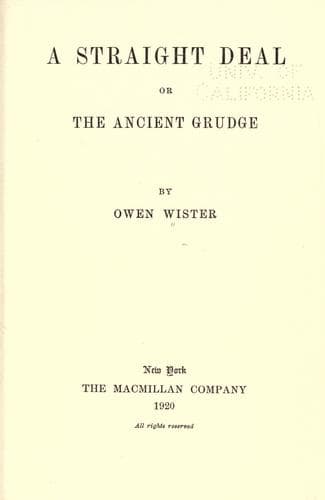
A Straight Deal; Or, The Ancient GrudgeWister, Owen
History
A Straight Deal; Or, The Ancient Grudge
Wister, Owen
Great Britain -- Relations -- United States; United States -- Relations -- Great Britain
Is that enough? Enough to show what England did in the War? No, it is
not enough for such people as continue to ask what she did. Nothing
would suffice these persons. During the earlier stages of the War it
was possible that the question could be asked honestly--though never
intelligently--because the facts and figures were not at that time
always accessible. They were still piling up, they were scattered about,
mention of them was incidental and fugitive, they could be missed by
anybody who was not diligently alert to find them. To-day it is quite
otherwise. The facts and figures have been compiled, arranged, published
in accessible and convenient form; therefore to-day, the man or woman
who persists in asking what England did in the war is not honest but
dishonest or mentally spotted, and does not want to be answered. They
don’t want to know. The question is merely a camouflage of their spite,
and were every item given of the gigantic and magnificent contribution
that England made to the defeat of the Kaiser and all his works, it
would not stop their evil mouths. Not for them am I here setting forth
a part of what England did; it is for the convenience of the honest
American, who does want to know, that my collection of facts is made
from the various sources which he may not have the time or the means to
look up for himself. For his benefit I add some particulars concerning
the British Navy which kept the Kaiser out of our front yard.
Admiral Mahan said in his book--and he was an American of whose
knowledge and wisdom Congress seems to have known nothing and
cared less--“Why do English innate political conceptions of popular
representative government, of the balance of law and liberty, prevail
in North America from the Arctic Circle to the Gulf of Mexico, from the
Atlantic to the Pacific? Because the command of the sea at the decisive
era belonged to Great Britain.” We have seen that the decisive era was
when Napoleon’s mouth watered for Louisiana, and when England took her
stand behind the Monroe Doctrine.
Public-domain text, read in full here on John Shaqi.
Reviews
Reviews
No reviews yet
Be the first to share your thoughts on this work.
Elsewhere in the archive
Join the Discussion
Join the discussion
Sign in to leave a comment or review.
Sign InorCreate an account