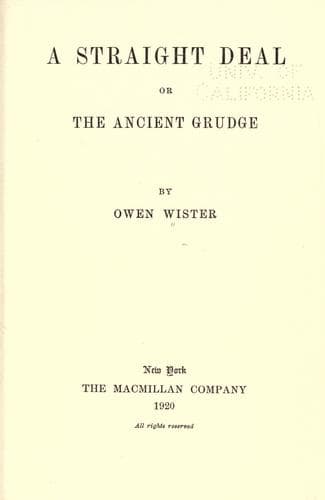
A Straight Deal; Or, The Ancient GrudgeWister, Owen
History
A Straight Deal; Or, The Ancient Grudge
Wister, Owen
Great Britain -- Relations -- United States; United States -- Relations -- Great Britain
It was, as you will observe, an unflattering interpretation of our
national initials, U. S. A. Of course it was enough to make a proper
American doughboy entirely “hot under the collar.” To this reading of
our national initials our national readiness retorted in kind at an
early date: A. E. F. meant After England Failed. But why, months and
months afterwards, when everything was over, did that foolish doughboy
in the hospital hug this lone thing to his memory? It was the act of an
unthinking few. Didn’t he notice what the rest of London was doing that
day? Didn’t he remember that she flew the Union Jack and the Stars and
Stripes together from every symbolic pinnacle of creed and government
that rose above her continent of streets and dwellings to the sky?
Couldn’t he feel that England, his old enemy and old mother, bowed
and stricken and struggling, was opening her arms to him wide? She’s a
person who hides her tears even from herself; but it seems to me that,
with a drop of imagination and half a drop of thought, he might have
discovered a year and a half after a few street roughs had insulted him,
that they were not all England. With two drops of thought it might even
have ultimately struck him that here we came, late, very late, indeed,
only just in time, from a country untouched, unafflicted, unbombed,
safe, because of England’s ships, to tired, broken, bleeding England;
and that the sight of us, so jaunty, so fresh, so innocent of suffering
and bereavement, should have been for a thoughtless moment galling to
unthinking brains?
I am perfectly sure that if such considerations as these were laid
before any American soldier who still smarted under that taunt in London
streets, his good American sense, which is our best possession, would
grasp and accept the thing in its true proportions. He wouldn’t want
to blot an Empire out because a handful of muckers called him names. Of
this I am perfectly sure, because in Paris streets it was my happy lot
four months after the Armistice to talk with many American soldiers,
among whom some felt sore about the French. Not one of these but saw
with his good American sense, directly I pointed certain facts out to
him, that his hostile generalization had been unjust. But, to quote the
oft-quoted Mr. Kipling, that is another story.
An American regiment just arrived in France was encamped for purposes of
training and experience next a British regiment come back from the front
to rest. The streets of the two camps were adjacent, and the Tommies
walked out to watch the Yankees pegging down their tents.
“Aw,” they said, “wot a shyme you’ve brought nobody along to tuck you
in.”
Public-domain text, read in full here on John Shaqi.
Reviews
Reviews
No reviews yet
Be the first to share your thoughts on this work.
Elsewhere in the archive
Join the Discussion
Join the discussion
Sign in to leave a comment or review.
Sign InorCreate an account